DocFusion

How to automate health insurance policy documents
Health insurance providers operate in one of the most document-intensive industries in the world. Every member interaction generates documentation, including policy schedules and welcome packs, benefit summaries, amendments, renewal notices, and claims correspondence. For medical insurers managing thousands or even millions of members, producing these documents accurately and consistently is a significant operational challenge.
The scale of the problem is substantial. The healthcare and insurance sectors process billions of documents every year, including policy documents, claims forms, medical records, and regulatory reports.
Yet many insurers still rely on outdated systems or manual processes to generate these critical documents. As membership grows and regulatory pressure increases, these processes quickly become inefficient, risky, and difficult to scale.
Automating health insurance policy documents has therefore become a key priority for insurers looking to improve operational efficiency, ensure compliance, and deliver better member experiences.
The document challenge medical insurers face
Health insurers must generate a wide range of policy-related documents every day. These documents must include the correct member details, policy information, benefit structures, regulatory wording, and sometimes region-specific conditions.
Producing these documents manually or through fragmented systems creates several problems.
High document volumes
The typical insurance claim involves 8 to 12 supporting documents, and a mid-sized insurer processing 5,000 claims per month may handle 40,000 to 60,000 documents every month. When each document takes 15 to 20 minutes to review manually, this can translate into thousands of hours of operational workload every month.
Compliance risk
Health insurance is heavily regulated. Every document must contain the correct wording, disclosures, and policy conditions. Without controlled templates, outdated or incorrect wording can easily be used, creating regulatory risk and potential penalties.
Inconsistent member communication
Different teams or systems may produce documents in different formats, with inconsistent branding or messaging. This affects trust and the overall member experience.
Operational inefficiency
Manual document handling consumes a significant amount of staff time. Studies show that insurance employees can spend up to 22 percent of their time on manual document-related tasks, including preparing, editing, reviewing, and managing documentation.
Limited personalisation
Members expect communication tailored to their specific policy and benefits. Legacy systems often struggle to generate dynamic, personalised documents at scale.
These challenges highlight a common reality in the insurance sector. Document generation is essential to the business, but the tools used to manage it are often inadequate.


Why document automation matters
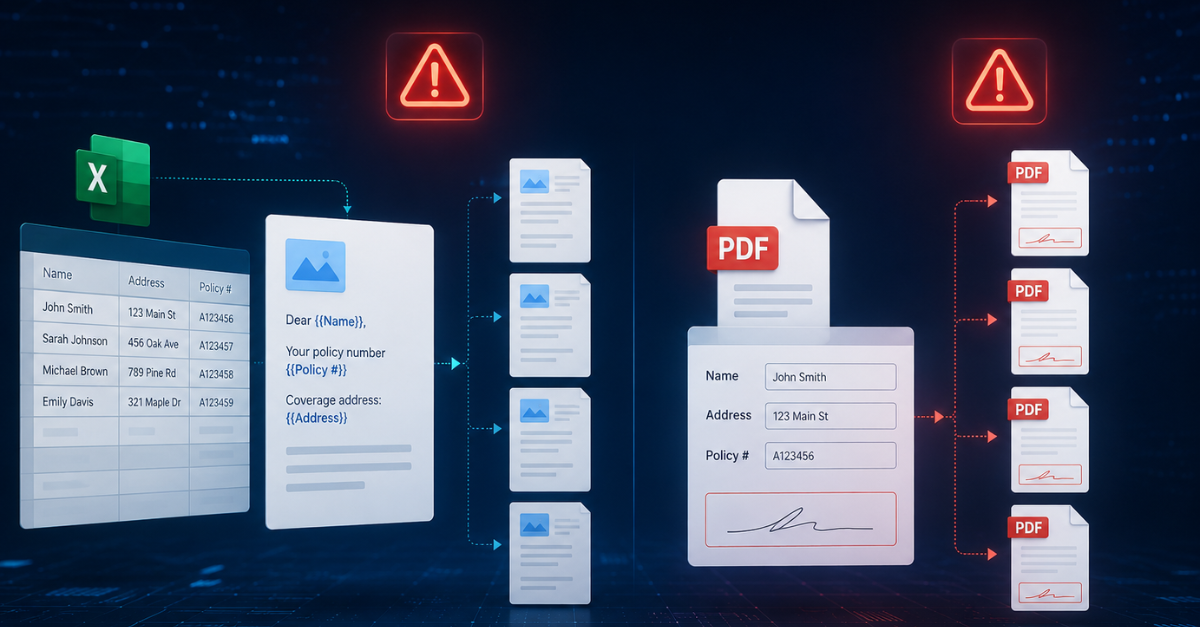
Automating health insurance policy documents transforms how insurers create and manage member communications. Instead of manually compiling documents, insurers can generate them automatically using controlled templates and real-time data from core systems.
Document automation enables insurers to:
- Generate policy schedules instantly when a policy is issued
- Automatically create welcome packs for new members
- Produce renewal notices with updated benefit information
- Generate claims related correspondence quickly and accurately
- Ensure every document follows the correct regulatory wording
Automation removes the need for manual editing and reduces the risk of human error.
The operational impact is significant. Document automation can reduce document processing costs by 30 to 50 percent while processing documents 10 to 15 times faster than manual workflows.
Automation also helps eliminate administrative workload. Some organisations report that document automation can reduce document-related administrative work by up to 70 percent after implementation.
Most importantly, automation enables insurers to respond more quickly to members and partners, improving operational performance and customer satisfaction.
Why DocFusion exists
DocFusion was created to solve the complex document challenges faced by industries that rely on high volume, highly personalised, and highly regulated documentation.
Insurance is one of the clearest examples of this challenge.
Medical insurers need to generate large volumes of policy and member documents while ensuring accuracy, compliance, and consistency. Traditional document generation tools or built-in system capabilities often fall short when it comes to handling complex templates, dynamic content, and regulatory requirements.
DocFusion was designed specifically to address this gap.
The platform enables organisations to generate sophisticated, data-driven documents directly from their existing systems. By separating document design from business systems, DocFusion enables insurers to manage templates centrally while automatically pulling the required data.
This means policy documents can be generated instantly and consistently, without manual intervention.
DocFusion also ensures that document templates are controlled, updated, and governed in one place. When regulations change or policy wording needs to be updated, templates can be adjusted centrally and applied across all generated documents.
This level of control is essential in regulated sectors like health insurance.
Why DocFusion is the best option
For medical insurers seeking to automate policy document generation, DocFusion offers a powerful, flexible solution.
DocFusion allows insurers to generate complex policy documents automatically using dynamic templates that integrate with core insurance systems, CRM platforms, and claims systems. This ensures that documents always include the correct member data, policy information, and regulatory content.
The platform is built to handle high document volumes, making it suitable for insurers with large member bases and growing operational demands.
DocFusion also provides strong governance and template management capabilities, helping insurers maintain compliance and consistency across all communications.
By automating the generation of policy schedules, welcome packs, benefit statements, and other critical documents, insurers can significantly reduce administrative workload while improving accuracy and speed.
Ultimately, DocFusion enables medical insurers to modernise their document processes, scale operations efficiently, and deliver clear, consistent communication to every member.
As healthcare systems and insurance providers continue to grow in complexity, automation is no longer a luxury; it is essential. It is a necessity. DocFusion provides the technology that allows insurers to meet this challenge confidently.