DocFusion

Insurance document generation: Why mail merge and PDF fillers break at scale
Insurance runs on documents. Policy schedules, claims correspondence, regulatory disclosures, renewal notices, welcome packs, annual statements. Almost every customer interaction eventually becomes a document.
Yet many insurance platforms still treat document generation like a side feature. Teams start with a Word mail merge, a templating library, or a PDF filler because they are quick to implement and easy to demo. At first, they work well enough. The problems only appear later, when the platform has to support real operational scale, compliance demands, and constant product changes.
The platforms that handle this well treat document generation as core infrastructure, not something bolted on after the fact.
Insurance documents are more complex than they look
The biggest mistake is assuming insurance documents are simple templates.
A retail invoice might contain a few fields and totals. An insurance policy document often contains layers of conditional logic that rival the underwriting engine behind it.
Take a single life insurance policy schedule:
- Product-specific sections appear or disappear depending on the product type, whether it is term life, whole life, endowment, or group cover.
- Rider clauses are added dynamically based on the customer’s selections, such as disability, critical illness, or accidental death cover.
- Beneficiary tables expand based on the number of beneficiaries listed.
- Regulatory disclosures differ by jurisdiction. A policy issued in one US state may require different wording from the same policy issued in another market.
- Multi-language support adds another layer of complexity, especially when formatting, character sets, and legal wording must remain accurate across English, French, German, Spanish, and Italian.
And that is just one document type.
Most insurance platforms generate dozens of document categories including endorsements, claims assessments, payment confirmations, renewal notices, lapse warnings, annual benefit statements, and tax certificates.
Each document type introduces its own rules, layouts, regulatory requirements, and conditional logic. Multiply that across product lines, jurisdictions, and languages, and the limitations of basic mail merge systems become obvious very quickly.
The mail merge and PDF filler trap
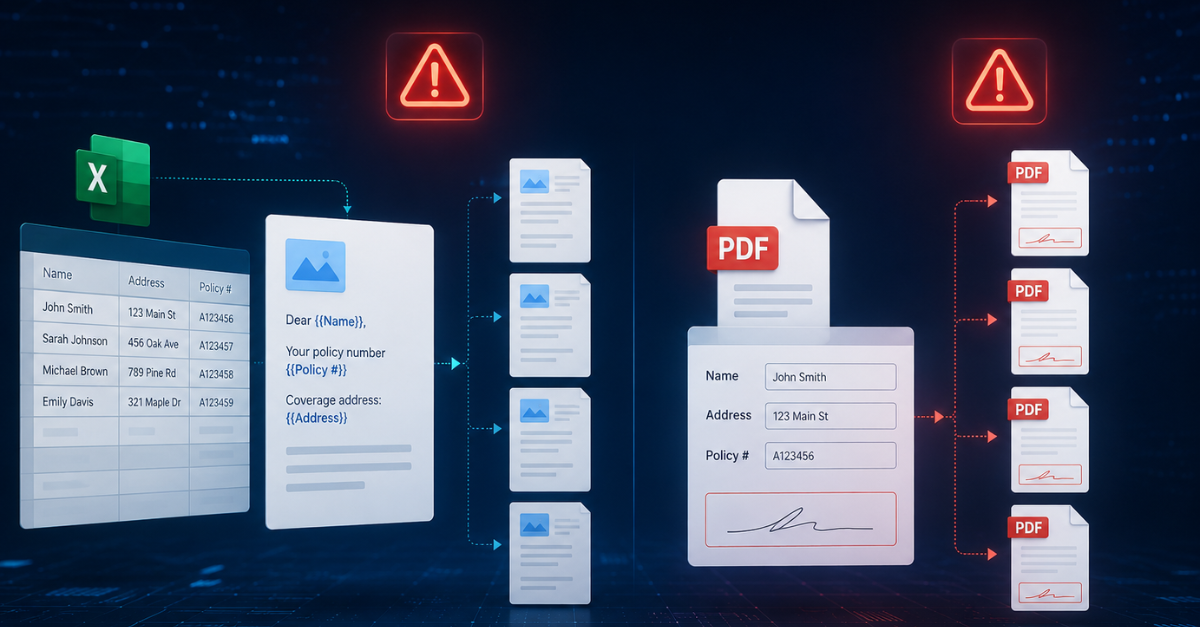
Most insurance platforms begin with one of two approaches:
- A mail merge setup using Microsoft Word or a templating library such as python-docx-template
- A PDF filler built around AcroForms, iText, PDFBox, or custom coordinate-based overlays
These approaches are attractive because they are fast to ship. Early document types usually work without much friction.
The problems emerge later, especially at scale.
No template governance
Whether templates live as .docx files in shared folders or PDFs in a repository, governance is usually weak or non-existent.
When compliance asks:
“Who changed this disclosure clause, and when?”
there is often no reliable answer.
No approval workflow. No version history. No audit trail.
In a regulated industry, that becomes a serious operational risk.
No segregation of duties
In many homegrown systems, the same developer who writes the generation logic also edits the templates.
That is a problem in insurance, where customer-facing documents are legal artefacts. Regulators expect clear separation between authors, reviewers, and approvers.
Without that separation, audit findings are almost inevitable.
Conditional logic ends up buried in code
Mail merge tools support only basic conditional logic. Word fields become difficult to manage once business rules become nested or product-specific.
PDF fillers are even more limited because they have no native conditional logic at all.
As complexity grows, business rules move into application code. Every product variation, disclosure update, or layout change requires developer involvement and a release cycle.
That creates bottlenecks for compliance and operations teams that need to move quickly.
Batch processing struggles under load
Insurance platforms regularly need to generate tens or hundreds of thousands of documents during renewal cycles, annual statements, or year-end reporting periods.
Basic mail merge pipelines were never designed for this level of throughput.
Microsoft’s own guidance for large Word mail merges has historically recommended splitting large jobs into smaller batches. That alone signals the limits of the tooling.
The risks become even clearer when software updates introduce instability. In April 2026, a regression in Office Monthly Enterprise Channel version 2603 caused Word to crash after mail merge runs. The only reliable fix at the time was rolling enterprises back to version 2602.
Regulated correspondence environments cannot depend on document generation systems that break because of a monthly Office patch.
Multi-format output creates fragmentation
Mail merge produces Word documents first, which then need separate PDF rendering.
PDF fillers only generate PDFs.
Over time, organisations end up with fragmented document pipelines:
- Mail merge for one document type
- PDF filling for another
- Reporting tools for a third
The result is inconsistent branding, formatting drift, font mismatches, and growing support overhead.
Multi-language support becomes a maintenance problem
Most homegrown systems treat every language as a separate template.
One document type in five languages quickly becomes five independent templates to maintain and govern. Every compliance update multiplies the effort.
Open-source licensing risks are often missed
Teams using open-source PDF libraries sometimes discover licensing issues only when preparing for production deployment.
A common example is iText, which moved from LGPL to AGPL licensing. For many closed-source SaaS platforms, that means either open-sourcing their application stack or purchasing a commercial licence.
These issues are often discovered late, usually during legal review or procurement.
Compliance risks are real
Insurance documents contain sensitive customer information and regulated disclosures.
Mail merge systems do not provide the controls that regulated communication environments require:
- Recipient isolation
- PII protection
- Auditable delivery records
- Clear template version tracking
The operational risk is not theoretical. Misdirected customer communications remain one of the most commonly reported GDPR-related incidents.
Mail merge may be better than manually sending emails with CC and BCC, but it is not enough for enterprise insurance operations.
Where mail merge and PDF fillers still make sense
There is still a place for these tools.
Mail merge works perfectly well for:
- Small HR communications
- One-off marketing campaigns
- Simple internal correspondence
PDF fillers are useful for fixed-layout government forms where the structure cannot change, such as tax submissions or regulatory filings.
The problems begin when document generation becomes:
- Customer-facing
- High-volume
- Compliance-sensitive
- Dynamic in layout or logic
At that point, homegrown systems stop being shortcuts and start becoming operational liabilities.
Template management is the real differentiator
The document engine matters, but template management is what separates enterprise-grade platforms from fragile implementations.
In insurance, effective template management includes:
- Role-based access control (RBAC)
- Full version history with rollback capability
- Approval workflows
- Segregation of duties
- Complete audit trails
These are not “nice-to-have” features. They are part of operating responsibly in a regulated industry.
Platforms that invest in template governance find that document generation becomes an advantage during audits rather than a weakness that needs explaining.
How embedded document generation works
The alternative to maintaining custom mail merge or PDF filling pipelines is embedding a purpose-built document generation and template management engine directly into the platform.
In practice, this means:
- Your platform continues to own the workflow, underwriting decisions, and customer experience.
- The platform sends structured data and a template reference through an API.
- The document engine generates the final output and returns it ready for delivery.
Templates are still designed in Microsoft Word, so business teams and compliance users can work in familiar tools rather than learning proprietary editors.
Conditional logic, repeating sections, and formatting rules live inside the template layer instead of being hardcoded into application code.
The result is better scalability, faster operational changes, and significantly stronger governance.
The insurance document generation checklist
If you are building or operating an insurance platform, ask yourself:
- Can you tell a regulator exactly who changed a template and when?
- Can compliance teams approve template updates before they go live?
- Can business users update document content without waiting for developers?
- Can your platform generate large renewal or annual statement runs without manual intervention?
- Are branding and formatting consistent across all document types?
- Does your document logic live in templates rather than application code?
If the answer to any of these questions is no, there are likely gaps in the current approach.
Key takeaways
Insurance documents are not simple templates with blanks to fill in. They are compliance-driven, logic-heavy documents that vary by product, jurisdiction, language, and customer configuration.
Mail merge systems and PDF fillers work well for small or fixed-use cases, but they struggle once document generation becomes part of a regulated, enterprise-scale insurance workflow.
The real challenge is not only generating documents. It is managing templates safely and at scale through governance, approvals, versioning, and auditability.
Embedded document generation infrastructure allows insurance platforms to keep ownership of the customer workflow while delegating document complexity, governance, and batch scalability to systems built for that purpose.
Ultimately, the real test comes during a compliance audit. If the platform cannot clearly show who changed a template, what changed, and when it happened, the document generation process becomes a liability.
Enterprise-grade document generation for insurance platforms
DocFusion is a document generation and template management engine built for insurance platforms handling regulated, high-volume document operations.
Policy schedules, claims correspondence, renewal batches, regulatory disclosures, and annual statements can all be generated at enterprise scale with built-in governance, versioning, approval workflows, and audit trails.
If your insurance platform is starting to outgrow a mail merge or PDF filler approach, book a technical discovery call to explore the architecture, governance model, and compliance integration in more detail.
Book a technical discovery call with us here.