DocFusion

What does modern document generation look like in 2026? – A reference architecture for legacy CCM modernisation
Modern document generation is now one of the defining architectural conversations inside enterprise technology renewal cycles. Modern document generation is no longer simply about producing PDFs, statements, or customer correspondence at scale. Modern document generation is about replacing rigid legacy CCM architecture with API-first services that fit inside modern enterprise systems. Modern document generation is about giving business teams ownership over templates and workflows without creating dependency on developer queues. Modern document generation is about deployment flexibility, governance, scalability, and operational resilience across cloud, on-premises, and hybrid environments.
Most enterprises still running a legacy customer communications platform are now approaching a renewal decision where the architectural limitations of the old model are becoming impossible to ignore, and modern document generation is increasingly the alternative being evaluated. The platforms many organisations implemented ten or fifteen years ago were designed for monolithic batch processing, proprietary template tooling, tightly controlled infrastructure, and release cycles owned almost entirely by IT operations teams.
The problem is that enterprise architecture moved on while many CCM platforms did not, and modern document generation emerged specifically because enterprises needed a fundamentally different operating model. Organisations now require document-generation services that integrate cleanly into cloud-native systems, expose APIs as first-class interfaces, support governed business-user ownership, and operate consistently across regulated deployment environments.
For many enterprises, the renewal conversation is still framed as a binary choice: remain on the existing on-premises platform or migrate to the vendor’s cloud edition. What often goes unaddressed is that both options typically preserve the same architectural assumptions that modern document generation was created to replace. The infrastructure model may change, but the underlying operational complexity, template ownership friction, deployment rigidity, and integration debt frequently remain.
This is where the DocFusion layer represents a different architectural approach, and why modern document generation is increasingly being evaluated as a peer category rather than a feature upgrade. Instead of acting as a standalone batch-output platform, the DocFusion layer operates as an enterprise service that sits inside the broader architecture and responds to business events generated by core systems.
A banking platform triggers statement generation. A policy administration system generates renewal packs. A CRM initiates personalised quotes. A digital onboarding workflow creates contracts in real time. In each case, modern document generation becomes an embedded service layer rather than an isolated operational platform.
The renewal decision and the hidden architectural question
Most organisations entering a renewal cycle already recognise that their incumbent platform is receiving less strategic investment, and modern document generation is increasingly part of the reason procurement teams are reassessing the category itself. Several legacy CCM vendors are now directing their primary roadmap focus toward cloud editions while reducing investment in on-premises deployments. Others are restructuring support models, consolidating product lines, or repositioning their platforms around adjacent AI narratives rather than core architectural modernisation.
The issue is not whether cloud deployment matters. It does. The issue is whether moving the same architecture into a vendor-managed cloud environment meaningfully solves the operational problems that modern document generation platforms were designed to address.
Many legacy environments still depend on proprietary template formats, specialised implementation skills, tightly coupled infrastructure, and administrative interfaces that act as the centre of the operating model. Modern document generation changes that model completely by treating the document layer as an extensible service architecture rather than a standalone system.
The four pillars of modern architecture
Modern document generation in 2026 is defined by four architectural pillars, and the DocFusion layer is designed around all four simultaneously rather than treating them as optional enhancements.
API-first architecture
Modern document generation platforms operate as services invoked directly by enterprise applications. The DocFusion layer exposes document generation through REST APIs, OpenAPI specifications, OAuth-secured integrations, and workflow-driven orchestration. Templates, workflows, and output configurations become governed resources that can be versioned, deployed, and managed programmatically.
This architectural approach matters because modern enterprises no longer want document generation to function as a disconnected operational silo. Modern document generation succeeds when it behaves like every other enterprise service inside a cloud-native architecture.


Business-user-driven authoring
One of the largest operational bottlenecks in legacy CCM environments is template ownership, and modern document generation addresses this directly. Business teams own the wording and compliance requirements, but developers often remain responsible for implementation. The result is slower turnaround, release-cycle dependency, and long-term maintenance overhead.
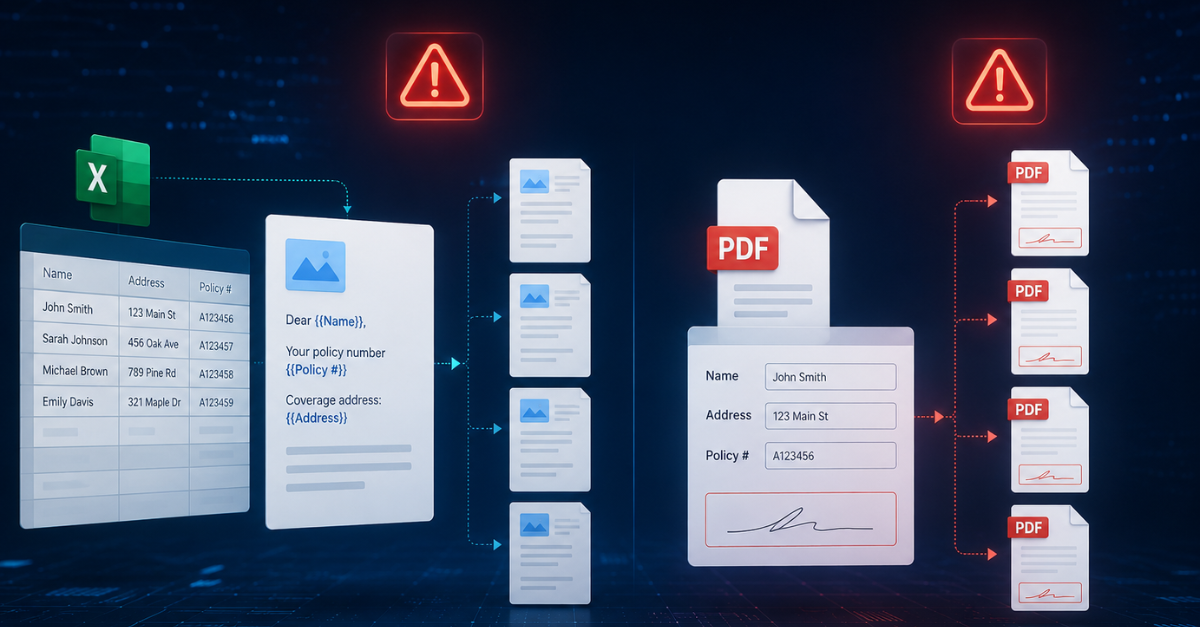
The DocFusion layer changes this model by allowing templates to be authored inside familiar tools such as Microsoft Word while still supporting governed workflows, approvals, version control, and structured business logic. Conditional sections, dynamic tables, localisation rules, and reusable content structures exist alongside the document content itself.
This is one of the defining operational advantages of modern document generation because it moves template ownership closer to the teams that actually manage the customer communication lifecycle.
Deployment flexibility
Modern enterprises rarely operate entirely in one infrastructure model anymore, and modern document generation platforms must therefore support multiple deployment strategies simultaneously. Some organisations require dedicated cloud environments. Others must retain regulated workloads on-premises. Many need hybrid operating models that span multiple regions or business units.
The DocFusion layer supports cloud, dedicated cloud, on-premises, and hybrid deployment models using the same templates, APIs, and operational structures. Modern document generation becomes significantly more valuable when deployment flexibility exists without requiring architectural rewrites or operational divergence between environments.
Governance-native design
Governance requirements continue to expand across regulated industries, which is why modern document generation platforms increasingly treat governance as a core architectural capability rather than a reporting add-on. The DocFusion layer supports version tracking, role-based access control, audit history, retention management, and reconstructable document lineage as native platform functions.
Every generated document can be traced back to the originating data payload, workflow execution, template version, and approval state. Modern document generation is no longer simply about producing output; it is about producing governed, defensible, and auditable customer communications at enterprise scale.
Why legacy CCM architecture struggles to modernise
The challenge facing many incumbent platforms is structural rather than cosmetic, and modern document generation exists largely because those structural limitations are difficult to retrofit. Legacy CCM platforms were originally architected around monolithic batch-processing systems with proprietary tooling, fixed deployment assumptions, and tightly coupled operational models.
Moving those systems into a vendor-managed cloud environment does not fundamentally transform the architecture. A REST interface added to a monolithic system does not create an API-first platform. Proprietary template tooling does not become business-user-friendly because the deployment target changes. Governance complexity does not disappear simply because the infrastructure becomes hosted.
This is why the architectural gap between legacy CCM and modern document generation continues to widen rather than narrow. The operational assumptions underneath the platforms are fundamentally different.
What enterprises should evaluate in 2026
As the category evolves, modern document generation is also changing the way enterprises evaluate document platforms during procurement and renewal exercises. Historically, evaluation criteria focused heavily on throughput, print fidelity, and output-channel support. Those capabilities still matter, but they are no longer the primary differentiators.
The more important questions now are architectural:
- Is every major capability exposed through APIs?
- Can business users safely manage templates without developer dependency?
- Can the same platform operate consistently across cloud, on-premises, and hybrid environments?
- Does the platform support auditability and governance natively?
- Can the architecture scale reliably under enterprise production workloads?
Modern document generation platforms increasingly compete on these criteria because they determine whether the platform aligns with long-term enterprise architecture strategy rather than short-term operational replacement.
Enterprise-scale proof
One of the most persistent assumptions in the market is that modern document generation platforms are suitable primarily for mid-market workloads while legacy CCM remains necessary at the top end of enterprise scale. The operational reality increasingly contradicts that assumption.
The DocFusion layer already supports enterprise-scale environments generating approximately thirty million pages per month from a single deployment. End-of-month statement processing can handle approximately one million records within a twelve-hour batch window while maintaining production success rates approaching 99.9999% across millions of records.
The important architectural point is not simply throughput. It is that modern document generation principles, including API-first integration, governed business-user authoring, deployment flexibility, and governance-native operation, now operate successfully at enterprise scale without reverting to legacy architectural assumptions.
The strategic importance of the renewal window
For many enterprises, the renewal cycle is the only realistic moment where architectural change remains commercially efficient, and modern document generation is increasingly being evaluated precisely during this window. Once organisations commit to another long-term licensing cycle, the operational and financial cost of future migration becomes significantly higher.
That is why the most important question is no longer whether to stay on-premises or move to a vendor-managed cloud edition. The more important question is whether the organisation still wants to operate inside legacy CCM architecture at all.
Modern document generation in 2026 is not simply a deployment evolution. It is a different architectural model built around service-based integration, business-user ownership, deployment flexibility, and governance-native design. The DocFusion layer is designed specifically to provide that architecture inside modern enterprise environments.
Contact us here.