DocFusion

What Modern Document Generation Looks Like in 2026: A Reference Architecture for Legacy CCM Modernisation
Modern document generation in 2026 is API-first, business-user-empowered, deployment-flexible, and governance-native. DocFusion is built around these four pillars and is the reference architecture this article describes. The platform runs as a service inside enterprise architectures rather than as a packaged batch-output suite. It treats template authoring as a business-user discipline, not a developer queue. It scales from a single contract to thirty million pages a month without changing platforms. And it is built to be re-hosted across cloud, on-premises, or hybrid deployments without rewriting either templates or integrations.
Most enterprises running a legacy customer communications platform (what your team may still call your CCM, your batch-output system, or your printing solution) are now inside a renewal-cycle decision. The framing they are usually offered is binary: stay on the on-prem platform that is visibly losing investment, or accept the vendor’s cloud edition as the natural next step. Both options keep the customer inside the same vendor relationship. Both treat the architectural question as already settled.
There is a third option, and it is the one this article exists to make visible. Evaluate the modern document generation category at renewal as a peer choice, not as an exotic alternative. The renewal window is the last commercial moment when re-platforming is cheap, and the architectural distance between a legacy CCM stack and a modern document generation platform is now wide enough that pretending otherwise is what the procurement category quietly calls a category error.
The Renewal Decision and the Option That Doesn’t Get Framed
If you are reading this, your incumbent platform is probably one of the names that does not appear in this article on purpose. Several of them have published end-of-support windows that land in 2026 or 2027. Several others have, without saying it directly, redirected investment to a successor cloud edition while leaving the on-prem footprint on a maintenance trickle. A smaller group has been visibly reshaping its own organisation: AI-first CEO mandates, multiple rounds of layoffs landing on support engineers, IT staff rebadged to outsourced providers. In April 2026, a marquee legacy CCM customer publicly completed migration to a peer competitor, quietly confirming that the third option is no longer a contrarian play. Either way, your renewal is the one moment in the next five years when the decision is actually open.
The decision you are usually offered has two doors. Door one is to stay: accept the upgrade-light cadence and quietly hope that the next acquisition or AI-pivot announcement does not change the maintenance equation. Door two is to take the vendor’s cloud edition, which is presented as a continuation but is functionally a re-platforming with a new licence, new architecture, new integration surface, and new lock-in. There is a third door, and the vendor narrative is built so that you do not see it. The third door is to evaluate the modern document generation category as a peer choice.
That door has gone unframed for a structural reason. The criteria most enterprises use to evaluate document platforms were written when the legacy stack was still investment-grade. They reward batch volume, output channel coverage, and proprietary formatting fidelity. They penalise nothing about template-authoring friction, integration debt, or deployment lock-in. In 2026 those are exactly the dimensions where the architectural gap is widest. Evaluating against 2014 criteria is how a renewal becomes a foregone conclusion.
What “Modern” Actually Means: The Four Pillars
The modern document generation category in 2026 is defined by four pillars. Each one is a specific architectural choice, not a marketing posture. Together they are what an enterprise architect should be evaluating against, and what a legacy CCM platform was not built to provide.
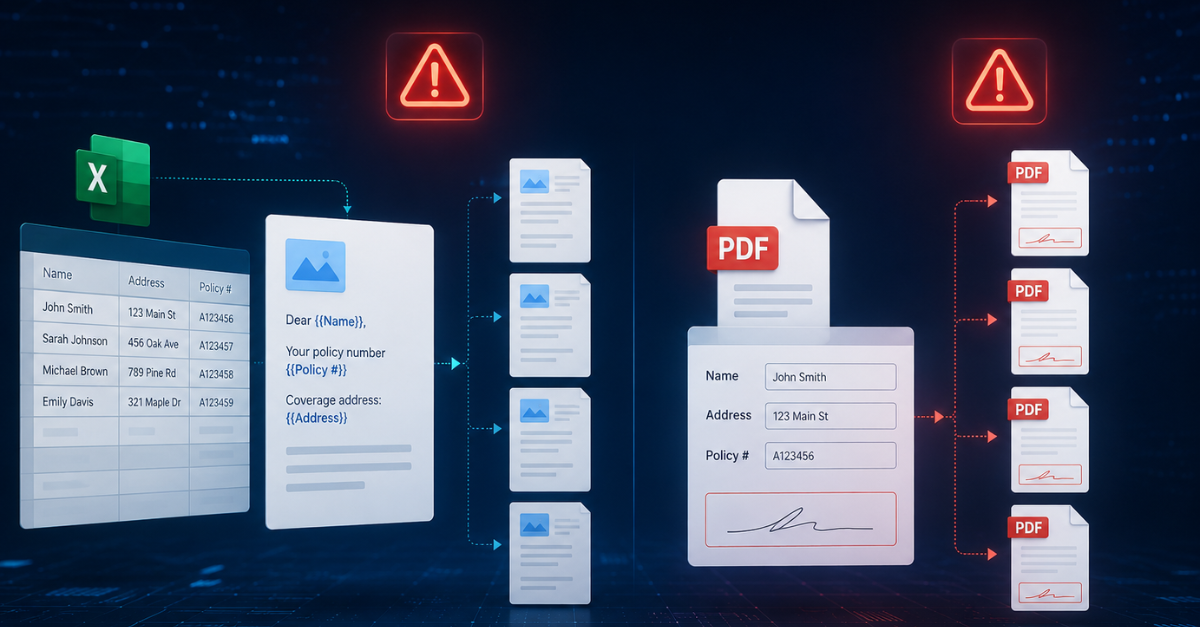
- API-first. The platform is a service, called from whatever owns the customer event. A core banking system raises a statement run; a policy admin platform raises a renewal pack; a CRM raises a personalised quote. The document engine receives the data, generates the document, and returns it through a REST endpoint with OpenAPI documentation, OAuth 2.0 authentication, and webhook callbacks. Templates and workflows are versioned resources; output configurations (format, encryption, watermarking, delivery) are first-class objects, not settings locked inside an admin UI. There is no front-end portal that has to be the entry point.
- Business-user-empowered. Templates are authored by the analyst who owns the product, in tools the business already knows. A familiar word processor (Microsoft Word in DocFusion’s case today) is the dominant authoring surface, with browser-based and AI-assisted authoring increasingly the norm across modern platforms and on DocFusion’s public roadmap. There is no proprietary markup language standing between the analyst and the document, and no developer queue standing between an idea and a live template. Conditional sections, dynamic tables, locale-aware formatting, and rules-based content live alongside the body copy in the same authoring surface the business uses to draft the original. Versioning, check-in/check-out, and approval workflows sit on top so governance survives the freedom. The IT release cycle stops being the rate-limiting step on a new product wording.
- Deployment-flexible. The same platform runs in cloud (shared or dedicated), on-premises, or hybrid configurations, using the same templates and the same APIs. A regulator that requires data residency in-country gets a dedicated deployment. A scale-up that wants no infrastructure ownership gets the shared cloud edition. A bank that has to keep batch processing on-prem and customer-self-service in the cloud gets a hybrid split. There is no Usage Policy capping the number of pages per month or the AWS region the data may touch.
- Governance-native. The platform treats audit, role-based access, version history, retention, and compliance posture as primitives, not bolt-ons. SOC 2 Type 2 and GDPR confirmation are baseline. Every template change is attributable. Every batch run is reconstructable. The documents the platform produces are evidentially equivalent to the data that produced them, with a chain of custody that survives a regulator asking who approved this wording on this date.
Treat any one of these as optional and you are buying a 2018 architecture with a 2026 release date.
Why the Legacy Architecture Cannot Retrofit Its Way Forward
The honest version of the cloud-edition pitch is that the legacy CCM platform was never designed for any of the four pillars, and you cannot retrofit them by lifting and shifting.
Legacy CCM stacks were architected as monolithic batch-output systems with proprietary template formats, a single dominant deployment model, and an admin console as the assumed entry point. Putting the same monolith in a vendor-managed cloud and adding a REST shim does not make it API-first; it makes it a monolith with a REST shim. The proprietary template format does not become open or business-author-friendly because the cloud edition has a new logo. The deployment lock-in becomes worse, not better, because the on-prem escape hatch quietly stops being a supported configuration. Governance gets a new dashboard but inherits the same data model the auditor already complained about.
This matters at renewal because the architectural gap is widening, not narrowing. Modern document generation platforms have spent the last four years rebuilding around microservices, elastic compute, fair-share scheduling across customer workloads, and external generator support. The legacy platforms have spent the same period absorbing acquisitions, releasing AI add-ons that paper over the data model, and pricing the on-prem renewal in a way that signals, without saying, that the cloud edition is the strategic product. The longer the renewal cycle waits, the further the gap moves and the more expensive the eventual move becomes.
What 2026 Evaluation Criteria Look Like
If the four pillars are the architectural reframe, the procurement reframe is what the criteria themselves look like in an RFP that takes the third option seriously. The questions below replace 2014-era throughput-and-format checklists.
- API-first. Is every action available as a documented REST endpoint? Where is the OpenAPI specification? Can templates and workflows be created, versioned, and deployed through the API, with output configurations (format, encryption, delivery) addressable as first-class objects? What is the SDK story for .NET, JavaScript, and the data extractor formats?
- Business-user authoring. What does the analyst use to author a template: a familiar word processor, a browser-based editor, or a proprietary tool that requires its own training and licensing? Who in the buying organisation is qualified to maintain a template after the implementation partner leaves? What is the role separation between template author, approver, and operator?
- Deployment. Can the same platform run in cloud (shared or dedicated), on-premises, and hybrid using the same templates? Is the on-prem deployment a maintained product line or a legacy carve-out? Does the Usage Policy carry hidden caps on monthly volume, concurrent users, or geographic region?
- Governance. What is the SOC 2 scope and audit opinion? What is the GDPR posture? How is template change tracked end-to-end, and how is a single document tied back to the exact template version, data payload, and run that produced it?
- Scale. What is the published throughput per minute, the published peak in a real production batch window, and the success rate across millions of records? If the answer is “we’ll come back to you on that”, that is your answer.
The set is short on purpose. A platform that scores well on these five lines has earned a peer evaluation against your incumbent. A platform that does not is, at best, a 2018 architecture in 2026 packaging.
Proof at the Top End: A Tier-1 Bank, ~30M Pages a Month, One Deployment
The most common objection to the third option is scale. The assumption is that the modern document generation category is a fit for mid-market workloads, but that legacy CCM is the only architecture that survives at the top end. The assumption is wrong, and the proof is already in production.
A tier-1 bank we work with runs ~30 million pages a month from a single DocFusion deployment. End-of-month statement runs hit ~1 million records inside a 12-hour batch window with a measured success rate of 99.9999% across 2.26 million production records. Two failures across the whole sample, both originating in the input data, neither in the platform. Total system throughput is ~12,000 records per minute across concurrent batches, with single-batch dedicated compute at ~4,000 records per minute.
These are not numbers from a benchmark lab. They are the published operational profile of a banking deployment that has been in production for years. The architectural point is the relevant one: those numbers are produced by an API-first, deployment-flexible, governance-native platform with business-user-driven template authoring. The same four pillars, all the way through. The category does not collapse at the top end. The legacy framing that says it does is the framing the campaign exists to dismantle.
Key Takeaways
- Modern document generation in 2026 is defined by four pillars. API-first, business-user-empowered, deployment-flexible, governance-native. Treat any one as optional and you are buying a 2018 architecture in 2026 packaging.
- The renewal decision is a trinary, not a binary. Stay, take the vendor’s cloud edition, or evaluate the modern document generation category as a peer choice. The third option is what the dominant vendor narrative is built to keep invisible.
- Legacy CCM platforms cannot retrofit their way to the four pillars. A REST shim on a batch-output monolith is not an API-first platform. The architectural gap is widening, not narrowing.
- Procurement criteria need a 2026 refresh. Five questions (API surface, business-user authoring, deployment shape, governance posture, published scale) replace the 2014-era throughput-and-format checklist.
- Modern document generation scales to tier-1 bank workloads. A single deployment runs ~30 million pages a month with 99.9999% success across millions of records. The “modern is for mid-market” framing is incorrect.
- The renewal window is the leverage point. Re-platforming is cheap inside the renewal cycle and expensive outside it. The third option costs least when it is evaluated now, not when the maintenance trickle finally stops.
Book a Reference-Architecture Review
If your renewal window is open in the next 18 months, the cheapest hour you will spend on the decision is the one that puts your incumbent’s architecture next to a modern document generation reference architecture and asks where the four pillars actually live. Book a reference-architecture review with the DocFusion team. We will walk the four pillars against your current stack, your renewal terms, and your 2026-2030 architectural roadmap, and you will leave the call with a defensible peer-evaluation criteria set you can take into procurement.