DocFusion

What is document automation in South Africa?
Document automation in South Africa refers to the use of software and workflow technology to automatically create, manage, process, distribute, and store business documents with minimal manual intervention. South African organisations use document automation to streamline repetitive document-heavy processes such as customer onboarding, policy generation, contract management, invoicing, compliance documentation, and customer communications.
As businesses across South Africa continue modernising operations, document automation has become increasingly important for improving efficiency, reducing administrative overhead, and maintaining regulatory compliance. Organisations operating in highly regulated industries such as banking, insurance, lending, healthcare, telecommunications, and legal services are under constant pressure to process large volumes of documentation accurately and consistently.
Document automation helps businesses meet these demands by reducing manual work while improving speed, governance, and customer experience.
Why document automation matters in South Africa
South African businesses operate in a complex environment that includes evolving compliance regulations, growing customer expectations, and increasing pressure to digitise operations. Many organisations still rely heavily on manual document processes involving Microsoft Word templates, email approvals, printed forms, and shared network folders.
These manual workflows often create operational bottlenecks, inconsistent documentation, approval delays, and compliance risks. As document volumes grow, these inefficiencies become more expensive and more difficult to manage.
Document automation solves these challenges by creating standardised workflows that automatically generate and process documents using live business data. This allows organisations to improve turnaround times, reduce errors, and maintain consistency across every customer interaction.
For many South African enterprises, document automation is also a key part of broader digital transformation initiatives aimed at improving operational scalability and customer service delivery.
How document automation works
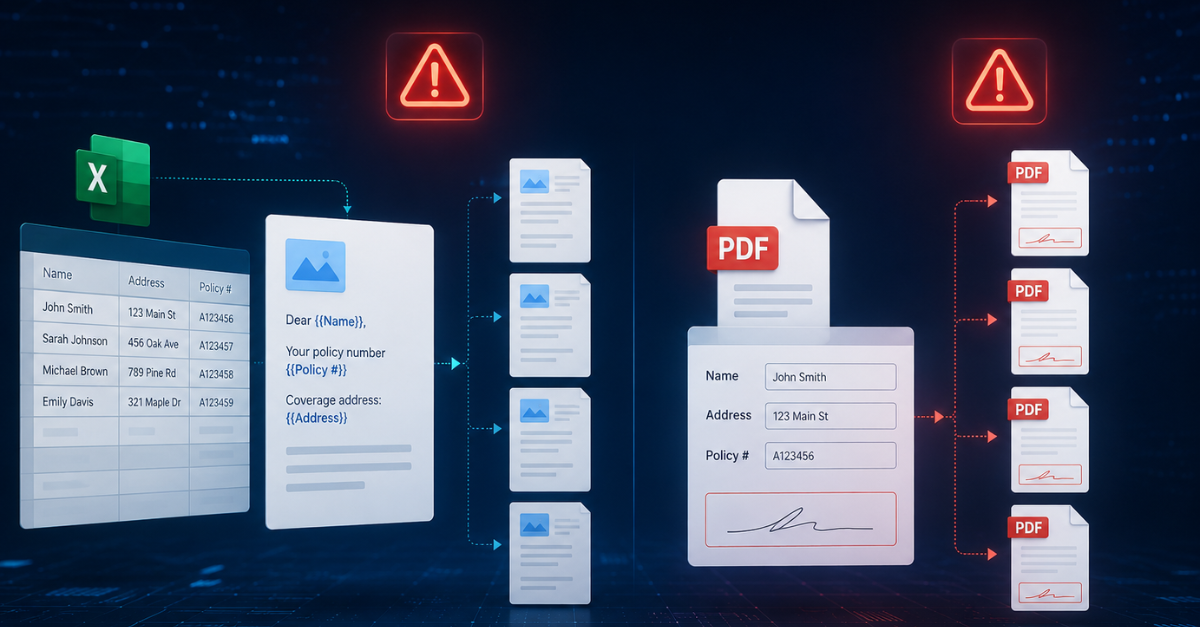
Document automation platforms connect directly to business systems such as CRMs, ERPs, banking platforms, insurance systems, databases, APIs, and web applications. The system retrieves structured data and automatically inserts that information into predefined templates designed with dynamic business rules and conditional logic.
Once generated, the document automation platform can also manage approvals, notifications, workflow routing, digital signatures, version control, and delivery.
For example, a South African bank may use document automation to generate customer loan agreements automatically based on loan value, repayment terms, interest rates, compliance requirements, and customer profile information. The system can then route the agreement for approval, generate audit logs, send the document for digital signing, and archive the final version without requiring manual intervention.


Industries in South Africa that rely on document automation
Banking and financial services
Banks, lenders, and financial institutions rely heavily on document automation to manage onboarding documents, FICA forms, loan agreements, account statements, credit applications, and regulatory communications.
As digital banking adoption grows in South Africa, document automation has become essential for improving customer onboarding and reducing operational friction.
Insurance
Insurance providers use document automation to manage policy schedules, claims documentation, underwriting communications, renewals, and customer correspondence.
Because insurance documentation often involves complex business logic and regulatory requirements, document automation helps insurers improve consistency while reducing manual processing workloads.
Telecommunications
Telecommunications providers use document automation for customer contracts, invoices, onboarding forms, service agreements, and billing communications across large customer bases.
Legal and professional services
Law firms and corporate service providers use document automation to streamline contracts, engagement letters, legal agreements, compliance documentation, and client communications.
Healthcare
Healthcare organisations use document automation to manage patient forms, billing records, medical documentation, and compliance-related communications more efficiently.
The role of compliance in South African document automation
Compliance is one of the biggest drivers behind document automation adoption in South Africa. Businesses must comply with regulations such as:
- POPIA (Protection of Personal Information Act)
- FICA (Financial Intelligence Centre Act)
- National Credit Act (NCA)
- FAIS regulations
- Industry-specific governance requirements
Manual document processes create significant compliance risks because outdated templates, missing disclosures, and inconsistent approval processes can expose organisations to legal and financial consequences.
Document automation platforms help reduce these risks by centralising document templates, enforcing approval workflows, maintaining audit trails, and ensuring that the correct regulatory content is always included in generated documents.
The difference between document automation and document generation
Although the terms are often used interchangeably, document generation and document automation are slightly different.
Document generation focuses specifically on creating documents automatically from templates and structured data. Document automation includes the entire document lifecycle, including workflow automation, approvals, routing, notifications, and delivery.
For example:
- Document generation creates a policy document automatically
- Document automation creates the policy, routes it for approval, sends it for signing, archives it, and distributes it to the customer automatically
This broader operational functionality is why document automation has become such an important technology investment for enterprise organisations across South Africa.
Why legacy document workflows are holding businesses back
Many South African organisations still operate with fragmented document processes that rely on manual editing, disconnected systems, and email-based approvals. These workflows often slow down operations and make scaling difficult.
Common challenges include:
- Version control problems
- Slow approval cycles
- Human data entry errors
- Inconsistent customer communications
- Compliance risks
- High administrative costs
- Limited operational visibility
Modern document automation platforms eliminate many of these challenges by integrating document workflows directly into core business operations.
What South African businesses should look for in a document automation platform
When evaluating document automation solutions, South African organisations should prioritise:
Integration flexibility
The platform should integrate easily with existing systems and digital infrastructure.
Workflow automation
Approval management, notifications, routing, and business rules should be built into the platform.
Governance and compliance
Audit trails, access controls, version history, and regulatory support are essential for highly regulated industries.
Ease of use
Business users should be able to maintain templates and workflows without heavy developer dependency.
Scalability
The platform should support high-volume processing across departments, channels, and customer touchpoints.
Deployment options
Cloud, on-premises, and hybrid deployment flexibility is particularly important for South African enterprises with varying security and compliance requirements.
Why South African organisations are choosing DocFusion
As document processes become more complex, organisations need document automation platforms that combine scalability, governance, and operational simplicity. DocFusion provides enterprise-grade document automation through a modern API-first architecture that integrates directly into existing business systems.
DocFusion allows business users to design and manage templates within Microsoft Word while supporting advanced workflow automation, audit tracking, version management, and omnichannel delivery. This significantly reduces operational bottlenecks and improves agility across document processes.
DocFusion is particularly well suited to South African organisations operating in highly regulated industries because it supports strong governance controls, flexible deployment models, and enterprise-scale automation capabilities.
Whether deployed in cloud, on-premises, or hybrid environments, DocFusion enables businesses to modernise customer communications, improve compliance, and automate complex document workflows at scale.
Final thoughts
Document automation in South Africa has become a critical operational capability for organisations looking to improve efficiency, strengthen compliance, and support digital transformation initiatives.
As customer expectations continue rising and regulatory environments become more demanding, businesses that rely on manual document workflows will struggle to scale effectively. Modern document automation platforms help organisations streamline operations, improve customer experiences, reduce risk, and create more agile business processes.
For South African enterprises focused on long-term operational growth and digital transformation, document automation is no longer optional. It has become essential infrastructure for modern business operations.
Discover how DocFusion helps enterprises streamline document automation. Contact us today.
Find out more & stay in the loop
🔗 Follow us on LinkedIn: https://www.linkedin.com/company/docfusion-cloud
▶️ To subscribe to our YouTube channel, click here: https://bit.ly/SubscribeDocFusion