DocFusion

What is document automation?
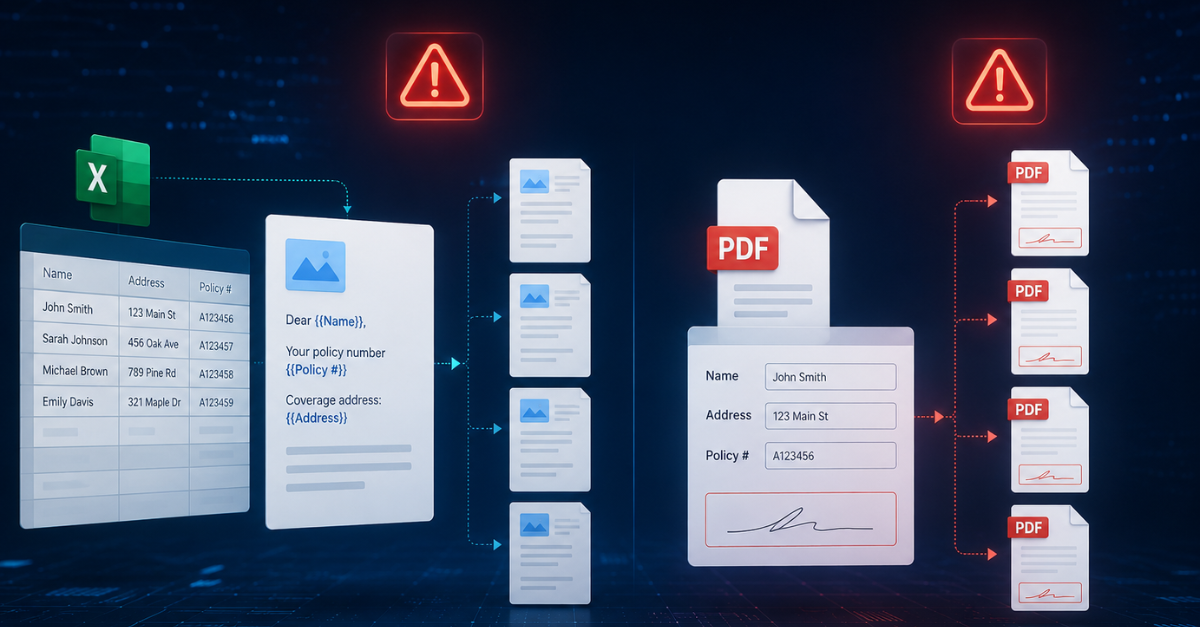
Document automation is the overarching process of using software to automatically create, manage, generate (document generation), distribute, and process business documents with minimal manual intervention. Document automation helps organisations streamline repetitive document tasks by connecting templates, workflows, business rules, and live data sources into a single automated system.
Modern businesses use document automation to generate contracts, invoices, onboarding documents, insurance policies, compliance forms, statements, proposals, customer communications, and internal operational documents at scale. Instead of manually copying information into templates or editing PDFs one document at a time, document automation allows businesses to create accurate and standardised documents automatically using structured business data.
As organisations continue digitising operations, document automation has become an essential part of improving operational efficiency, customer experience, compliance, and scalability.
How document automation works
Document automation works by connecting business systems to predefined document templates and workflow rules. A document automation platform retrieves data from systems such as CRMs, ERPs, banking platforms, insurance systems, databases, APIs, or web applications and inserts that information into dynamic templates.
The document automation engine then applies conditional logic, calculations, formatting rules, approvals, and content variations before producing the final document output. Documents can be delivered as PDFs, Microsoft Word files, emails, HTML documents, or digital forms depending on the organisation’s requirements.
For example, a financial services provider using document automation may automatically generate customer loan agreements based on product type, loan amount, interest rates, compliance requirements, and customer information without requiring manual intervention from staff.
Why businesses are investing in document automation
Many organisations reach a point where manual document processes begin slowing operations down. Employees spend hours preparing documents, correcting errors, managing approvals, and reusing outdated templates. As document volumes increase, the risk of inconsistencies and compliance issues also increases.
Document automation solves these challenges by creating standardised, repeatable workflows that reduce human error and accelerate document creation. Businesses can process higher document volumes while maintaining accuracy, consistency, and compliance across every customer interaction.
In competitive industries where customer expectations are rising, document automation also improves responsiveness. Customers receive documents faster, onboarding becomes more efficient, and internal teams spend less time on repetitive administration.
The difference between document automation and document generation
Although the terms are closely related, document automation and document generation are not exactly the same.
Document generation focuses specifically on creating documents automatically from templates and data. Document automation goes further by automating the entire document lifecycle, including workflows, approvals, routing, version management, and delivery.
For example:
- Document generation creates a customer contract automatically
- Document automation creates the contract, routes it for approval, applies business rules, triggers notifications, and sends it to the customer automatically
This broader operational capability is why document automation has become such an important part of enterprise digital transformation strategies.
Common business processes improved by document automation
Customer onboarding
Businesses use document automation to streamline onboarding by automatically generating contracts, welcome packs, compliance forms, and verification documents.
Financial services documentation
Banks and lenders automate loan agreements, account opening forms, credit documentation, and customer disclosures using document automation platforms.
Insurance communications
Insurance providers use document automation for policy schedules, claims correspondence, renewals, underwriting documentation, and compliance notices.
Human resources
HR departments automate employment contracts, onboarding documents, policy acknowledgements, and internal forms.
Legal agreements
Legal teams use document automation to standardise contracts, engagement letters, NDAs, and client agreements while reducing manual drafting work.
Benefits of document automation
Faster document processing
Document automation dramatically reduces the time required to prepare and distribute business documents.
Improved accuracy
Because document automation uses structured data directly from business systems, the risk of manual data entry errors is significantly reduced.
Better compliance
Automated workflows help ensure that the correct legal clauses, disclosures, and regulatory wording always appear in the appropriate documents.
Reduced operational costs
Businesses reduce manual administration and free employees to focus on higher-value work instead of repetitive document preparation.
Greater scalability
As organisations grow, document automation allows them to manage larger document volumes without needing proportional increases in operational staff.
Improved customer experience
Customers receive faster, more consistent, and professionally branded communications across every interaction.
Why legacy document processes create problems
Many businesses still rely on outdated document workflows involving email approvals, manual Microsoft Word editing, shared folders, and static PDF templates. These processes often create bottlenecks, version control issues, inconsistent branding, and compliance risks.
Legacy systems also make it difficult for organisations to scale operations efficiently. As document complexity increases, manual processes become harder to manage and more expensive to maintain.
Modern document automation platforms eliminate these challenges by centralising templates, automating workflows, and integrating directly into existing business systems.
What to look for in a document automation platform
When evaluating a document automation solution, organisations should prioritise:
API-first integration
The platform should connect easily with existing business systems and applications.
Workflow automation
Approval routing, notifications, document tracking, and business rules should be built into the platform.
Template flexibility
Business users should be able to manage templates without relying heavily on developers.
Security and governance
Audit trails, access controls, version history, and compliance management are critical for enterprise environments.
Scalability
The platform should support high-volume document processing across departments and channels.
Deployment flexibility
Cloud, on-premises, and hybrid deployment options help organisations align with security and operational requirements.
Why organisations are choosing DocFusion for document automation
As document processes become more complex, organisations need platforms that combine automation, scalability, and operational flexibility. DocFusion provides enterprise-grade document automation through an API-first architecture designed to integrate seamlessly with existing business systems.
DocFusion allows business users to manage templates directly within Microsoft Word while supporting advanced workflow automation, approval management, audit tracking, and omnichannel delivery. This reduces developer dependency while improving operational agility.
Unlike many legacy platforms, DocFusion supports cloud, on-premises, and hybrid deployments while maintaining the same automation capabilities across environments. This flexibility is particularly valuable for highly regulated industries that require strong governance and deployment control.
For organisations looking to modernise customer communications, streamline operational workflows, and improve compliance, DocFusion provides a scalable document automation platform built for modern enterprise requirements.
Final thoughts
Document automation has evolved from a convenience tool into a critical operational capability for modern businesses. As organisations continue digitising operations and increasing customer expectations, the ability to automate document workflows becomes essential for maintaining efficiency, consistency, and scalability.
Businesses that invest in modern document automation platforms are better positioned to reduce operational costs, improve compliance, accelerate customer communications, and support long-term digital transformation strategies across the enterprise.
Discover how DocFusion helps enterprises streamline document automation. Contact us today.
Find out more & stay in the loop
🔗 Follow us on LinkedIn: https://www.linkedin.com/company/docfusion-cloud
▶️ To subscribe to our YouTube channel, click here: https://bit.ly/SubscribeDocFusion