DocFusion

From compliance to confidence: How DocFusion enables GDPR-ready document generation
Following a formal GDPR readiness assessment, DocFusion has reaffirmed its commitment to privacy-first document automation – empowering organisations to meet compliance obligations without compromising efficiency.
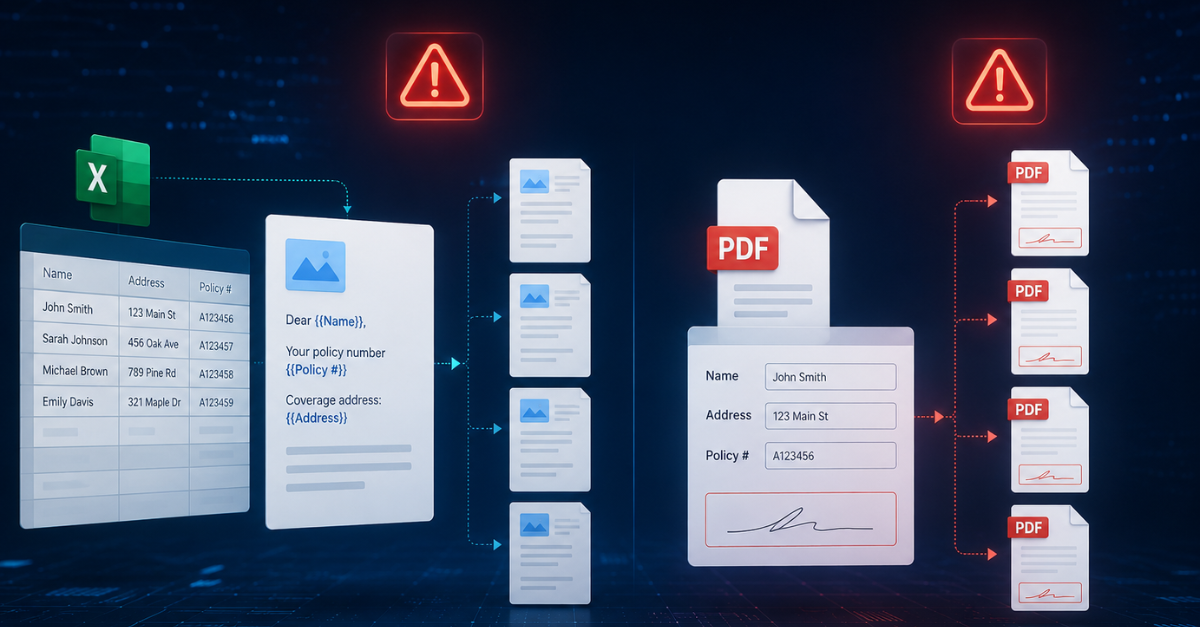
In today’s regulatory landscape, trust isn’t a trend; it’s an operational requirement. And for organisations that generate high volumes of personalised, data-rich documents, GDPR compliance isn’t limited to databases or CRM systems. Document generation itself is a critical – but often overlooked – component of data protection practices.
DocFusion document generation software, developed by Assimilated Information Systems (AIS), recently underwent an independent GDPR readiness assessment to validate how its systems, processes, and policies align with the General Data Protection Regulation (EU 2016/679). The assessment evaluated the platform across the full data lifecycle, from data ingestion to deletion, confirming that DocFusion is built on a strong privacy-by-design foundation supported by robust technical and organisational controls.
GDPR compliance in document generation: Why it matters
The GDPR remains the EU’s gold-standard regulation for personal data protection. While many organisations focus on securing databases, servers, and applications, fewer recognise that document generation platforms routinely process highly sensitive information – names, account details, financial disclosures, identification numbers, and more.
If these tools store unnecessary data, process it without transparency, or retain it longer than required, they can expose organisations to risk. This includes:
- Unauthorised access
- Excessive data retention
- Lack of audit trails
- Breaches involving personally identifiable information (PII)
Document generation is therefore a high-impact area of GDPR compliance. DocFusion solves this challenge through an architecture intentionally engineered to minimise, protect, and control customer data at every stage.
Privacy built in, not bolted on
DocFusion’s architecture is centred on privacy-by-design principles, not retrofitted controls. This was a key area validated in the GDPR readiness assessment.
Transient data processing
DocFusion processes all customer data without storing it – using it only to generate the required document and immediately discarding it after processing. No personal data is written to disk, retained, or included in backups.
Data minimisation as a default
Clients determine exactly what data they pass into DocFusion. The platform never adds additional fields, enriches data, or repurposes it for other functions.
Azure-backed security
Hosted on Microsoft Azure, DocFusion benefits from enterprise-grade redundancy, incident response, and infrastructure security. Encryption, access controls, and secure key management align with GDPR Article 32 (Security of Processing).
No secondary use, ever
Customer data is processed solely to fulfil the client’s instruction: Generating a compliant, branded, accurate document. Nothing more.
This approach ensures the platform naturally supports GDPR principles such as purpose limitation, minimisation, storage limitation, and integrity and confidentiality.


How DocFusion support Key GDPR principles
| Lawfulness, fairness & transparency | Processes data only under explicit client instruction, with no secondary uses. |
| purpose limitation | Data is used solely to generate documents—nothing is repurposed. |
| Data minimisation | Clients control all inputs; DocFusion does not add or store extra data. |
| Storage limitation | All customer data is deleted immediately after processing. None is retained or backed up. |
| Integrity & confidentiality | Encryption, secure authentication, least-privilege access, and Azure infrastructure protections. |
What sets DocFusion apart
DocFusion is more than a document generator. It is a trusted data processor built for regulated industries that demand accountability, security, and transparency.
Other platforms frequently store user data, provide limited control over retention, or offer questionable visibility into data flows. DocFusion’s architecture avoids these risks entirely.
AIS supports this with an extensive governance framework, including:
- Data Privacy Policy
- Data Retention Policy
- Access Management Policy
- Encryption and Key Management Standards
- Disaster Recovery Procedures
These policies ensure that DocFusion consistently aligns with GDPR best practices, making it a reliable solution for finance, healthcare, legal, public sector, and other regulated environments.
Practical benefits for clients
Beyond compliance, DocFusion helps organisations simplify governance and strengthen trust.
Reduced exposure to breach risk
Transient processing and the absence of data retention significantly reduce the potential impact of a breach.
Simplified audits & DPIAs
Clear data flows, documented controls, and transparent processing make audits and Data Protection Impact Assessments smoother.
Strong controller–processor alignment
DocFusion provides the clarity and accountability required under Article 28, essential for regulated industries.
Visible privacy commitment
Using DocFusion helps organisations demonstrate operational integrity to customers, partners, and regulators.
A commitment to trust and transparency
The GDPR readiness assessment reinforced what has always been core to DocFusion’s philosophy: privacy is not optional. It is an essential component of modern document automation.
By combining privacy-by-design engineering with robust operational governance, DocFusion gives organisations the confidence to automate at scale—without inheriting unnecessary compliance risk.
Learn more about DocFusion’s GDPR-aligned architecture
- Request our GDPR Compliance Summary
- Talk to our privacy team about secure document automation
- Learn how DocFusion helps you align with GDPR