DocFusion

Why 2026 is the year of orchestrated operations
The pressure on organisations is intensifying at a pace few predicted, and as we move into 2026, one capability stands out as essential: orchestrated operations. In industries with high compliance requirements, complex data flows, and document-driven processes, orchestrated operations are becoming the new baseline for resilience and efficiency.
The shift is no longer about automation alone – it is about how teams synchronise people, systems, and data through orchestrated operations that reduce risk and increase precision. For organisations aiming to scale without sacrificing accuracy or governance, 2026 is shaping up to be the definitive year of orchestrated operations.
Fragmented processes can no longer support modern demands
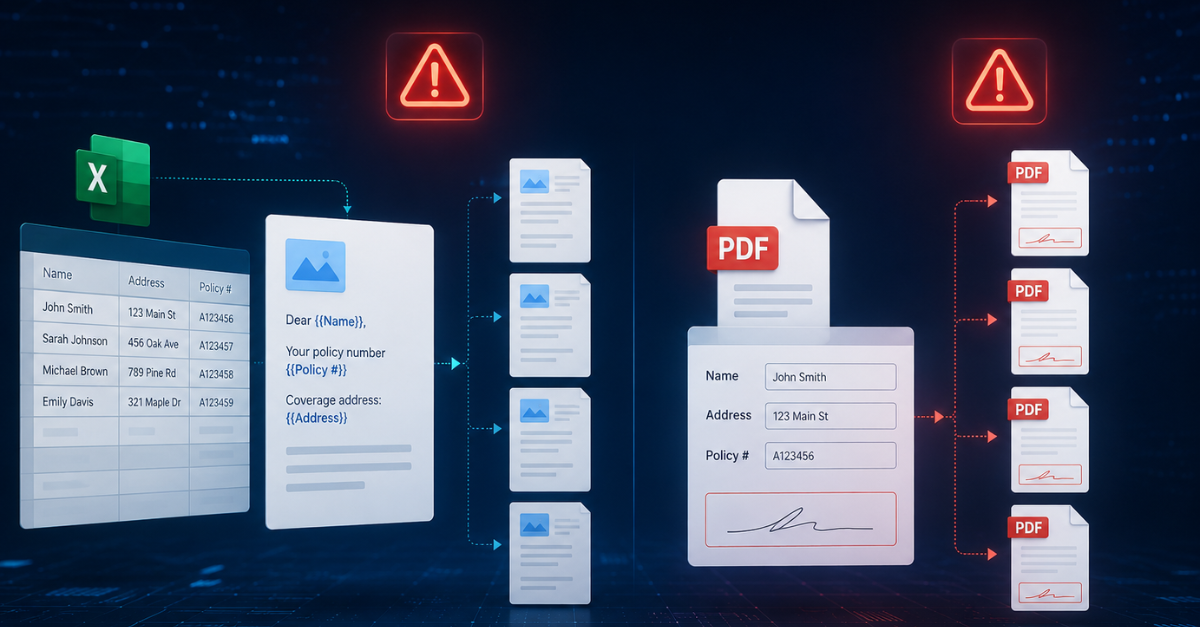
For years, organisations accepted fragmented document workflows, manual checks, disconnected systems, and template sprawl as unavoidable realities. Those days are ending. The economic, regulatory, and operational pressures of 2026 leave little room for unpredictable processes or inconsistent outputs.
Fragmentation now directly creates:
- Compliance exposure
- Operational delays
- Version drift and errors
- Limited visibility across document lifecycles
- Duplication of effort across teams
The cost of inefficiency is no longer just financial – it’s reputational and regulatory. Organisations need unified, predictable, governed processes that can support scale without losing control. This is where orchestrated operations become non-negotiable.
Automation without orchestration isn’t enough anymore
Traditional automation solved speed, but speed is now only part of the challenge. Modern businesses need accuracy, consistency, and traceability just as much as velocity.
Automation produces documents while orchestrated operations ensures the right documents are produced, with the right data, in the right sequence, under the right rules.
In 2026, the organisations that excel will be the ones that understand the difference. Automation accelerates output; orchestration governs it. Automation reduces manual effort; orchestration protects compliance, data integrity, and trust.
Data must flow intelligently – not incidentally
Data is the heartbeat of every document, workflow, and communication. Yet for many organisations, data still moves inconsistently across teams and systems. Manual preparation, shadow spreadsheets, inconsistent mapping, and outdated field controls all contribute to errors and slowdowns.
To operate at the expected pace of 2026, organisations must orchestrate their data – ensuring that inputs are validated, controlled, and used with intention. Orchestrated operations bring structure to how data enters, moves through, and exits a document process, eliminating the vulnerabilities created by ad hoc methods.
Only once data is orchestrated can compliance, accuracy, and speed coexist predictably.
This is why DocFusion enters the picture
The market is shifting from scattered automation to connected, governed, end-to-end orchestration. This is the exact space that DocFusion was designed to address – but it becomes relevant only once organisations recognise the limits of fragmented document operations.
DocFusion brings structure, predictability, and governance to document processes, enabling organisations to implement true orchestrated operations across compliance-heavy and high-volume environments.

How DocFusion enables orchestrated operations across the document lifecycle
DocFusion integrates the core elements required for operational orchestration:
1. Orchestrated data flow
DocFusion ensures consistent, validated, real-time data movement into templates without manual intervention.
- No duplication.
- No uncontrolled data sprawl.
- No unmanaged transformation.
2. Orchestrated compliance
Compliance is no longer a review at the end – it becomes an embedded rule set within templates, logic, and workflows.
Regulatory text, clauses, and conditions update globally and automatically.
3. Orchestrated document templates
With centralised version control, governed changes, audit logs, and controlled access, DocFusion eliminates template chaos.
Branding, logic, and rules stay consistent across departments and regions.
4. Orchestrated workflows
Trigger events, routing, approval paths, and output channels all follow governed, automated processes.
Documents behave predictably – every time.
Through these capabilities, DocFusion elevates document automation from isolated task execution to orchestrated operational control.
Supporting auditability, visibility, and high-volume stability
As regulatory expectations rise, organisations must demonstrate not only what was sent, but how it was generated, using what data, under which version, and via which workflow.
DocFusion supports this through:
- complete audit trails
- data provenance tracking
- template and version insight
- lifecycle monitoring
- GDPR-aligned transient processing
This level of operational clarity is essential for any organisation adopting orchestrated operations – especially those in finance, insurance, healthcare, energy, and the public sector.
Resilience becomes a competitive advantage in 2026
Unpredictable markets, regulatory pressure, and increasing digital complexity demand operational maturity. The organisations that thrive will be those whose operations do not depend on manual oversight or heroics from overstretched teams.
With DocFusion enabling orchestrated operations, document-heavy processes become:
- stable
- predictable
- scalable
- compliant
- traceable
2026 will be remembered as the year organisations moved beyond isolated automation and embraced orchestration as the foundation for operational resilience.
Contact us today and take your document generation to the next level.