DocFusion

Why fully integrated document automation succeeds.
Document automation was introduced to remove friction from business operations. The promise was simple. Reduce manual effort, improve accuracy, and accelerate outcomes. Yet for many organisations, document automation has delivered mixed results at best and operational risk at worst.
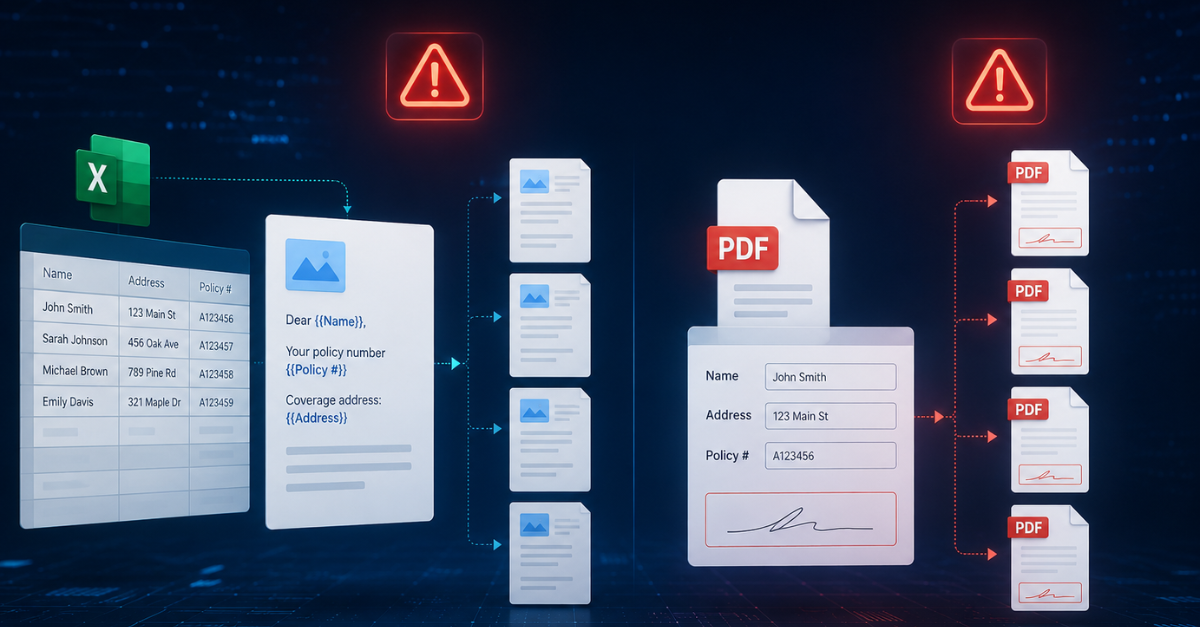
Documents are generated with missing or incorrect data. Teams intervene manually to correct outputs that were meant to be automated. Compliance teams struggle to understand where information originated or why specific clauses were included. Audits take longer, not less time. What was expected to streamline operations becomes another system to manage and monitor.
This is not a failure of intent. It is a failure of design.
At the heart of most unsuccessful document automation initiatives is the same issue. Automation is deployed in isolation, disconnected from the systems, data, and processes it depends on. When documents do not reflect the reality of the business, automation cannot deliver trust.
Why integration matters to document automation
At DocFusion, we believe documents are not just outputs. They are evidence. Evidence of decisions, transactions, compliance, and accountability. When documents are wrong, incomplete, or untraceable, trust erodes across the organisation.
This belief shapes why integration is essential.
Documents sit at the intersection of multiple systems. Customer data lives in CRMs. Financial data lives in ERPs. Case details live in line-of-business platforms. Policies, rules, and approvals sit elsewhere again. When document automation is disconnected from these systems, it can only produce a partial version of the truth.
The result is predictable.
Data is pulled from multiple sources without validation. Inconsistencies appear across documents. Teams rely on manual workarounds to correct errors. Visibility into how or why a document was produced is limited. Instead of reflecting live business processes, documents become static snapshots that quickly fall out of sync.
When automation operates in isolation, it does not remove friction. It exposes it.
This is why document automation succeeds only when it is integrated. Integration ensures documents reflect what is actually happening across the business, not what one system assumes to be true.
Why governance is inseparable from integration
Integration alone is not enough. Many organisations successfully connect systems, only to discover new risks emerging inside automated processes.
Without governance, automation amplifies mistakes.
Templates are changed without oversight. Clause logic is modified without traceability. No clear audit trail exists to show who changed what, when, or why. Compliance issues are hidden inside automated outputs that appear correct on the surface.
At scale, these risks grow exponentially. Automation accelerates everything, including errors.
This is where many document automation initiatives quietly fail. They focus on speed and efficiency, but neglect control. They automate faster, but not safer.
At DocFusion, we believe governance should not slow organisations down. It should protect them as they scale. That belief is fundamental to how we approach document automation.
How DocFusion approaches document automation differently
DocFusion was built on a simple principle. Documents should be governed outcomes of business processes, not standalone artefacts created at the end.
This is why integration is not an add-on in DocFusion. It is embedded at the core of the platform.
Instead of generating documents after the fact, DocFusion orchestrates document creation as part of connected workflows. Data, rules, approvals, and systems are coordinated so that documents are produced at the right time, with the right content, for the right reason.
This approach changes everything.
Documents are driven by live, validated data from connected systems. Business rules determine what content appears, under which conditions, and why. Every document is traceable from its source data through to final output. Governance is applied consistently, without adding complexity for users.
Integration in this context is not about moving data from point A to point B. It is about ensuring documents accurately reflect the state, intent, and compliance requirements of the organisation at the moment they are created.
How integrated document automation improves outcomes
When document automation is both integrated and governed, the impact is immediate and measurable.
Accuracy improves because documents are generated from trusted, validated sources rather than copied or rekeyed data. Manual intervention drops as exceptions are handled through rules and workflows instead of human correction. Compliance becomes simpler because traceability is built in, not retrofitted for audits. Operational confidence increases because documents can be trusted at scale.
Instead of being a source of risk, documents become a reliable asset.
Teams spend less time fixing issues and more time focusing on higher-value work. Compliance teams gain visibility rather than chasing evidence. Leadership gains confidence that automation is supporting the business, not exposing it.
This is what document automation was always meant to achieve.
What DocFusion delivers in practice
DocFusion brings together document generation, workflow orchestration, integration, and governance in a single platform.
In practical terms, this means organisations can connect their core systems through native integrations and APIs. Document generation is controlled through orchestrated workflows that define how and when documents are produced. Templates are governed through version control and role-based access. Full traceability is maintained from data source to document output.
Every component works together to ensure documents are generated correctly, consistently, and compliantly.
This unified approach removes the fragility that exists when document automation is layered onto disconnected systems. It replaces point solutions with a coordinated document infrastructure that scales with the organisation.
What makes DocFusion the right choice
Organisations choose DocFusion when document automation must work across teams, systems, and regions without introducing risk.
DocFusion is purpose-built for environments where accuracy matters as much as speed, compliance cannot be compromised, processes span multiple systems, and document volumes are high and growing.
By combining integration-first design with governance by default, DocFusion enables organisations to scale document automation with confidence.
Document automation does not fail because the technology is flawed. It fails when it is disconnected.
With DocFusion, integration is not an afterthought. It is the foundation.
Contact us to find out how integrated, governed document automation can transform your operations.