DocFusion

From document automation to orchestration, the shift begins now
For years, organisations have invested heavily in document workflow automation, hoping to streamline operations, reduce manual effort, and improve compliance. And while document automation delivered value, the next frontier is already here. The shift from document automation to orchestration is no longer theoretical. It is unfolding right now, driven by the growing complexity of enterprise ecosystems, rising compliance expectations, and the need for smart document infrastructure that can adapt, scale, and govern itself in real time.
Document Automation made individual tasks faster.
Orchestration makes entire operations smarter.
As organisations confront fragmented systems, multi-step approvals, conditional logic paths, cross-department dependencies, and increasingly strict governance requirements, the limitations of simple document automation become clear. A workflow that once worked in isolation now needs to integrate across CRM platforms, core business systems, cloud repositories, and regulatory controls. In this new reality, a workflow orchestration platform does what document automation alone cannot: coordinate, validate, enforce, optimise, and govern the full lifecycle of enterprise document generation.
Document Automation is no longer enough for modern document operations
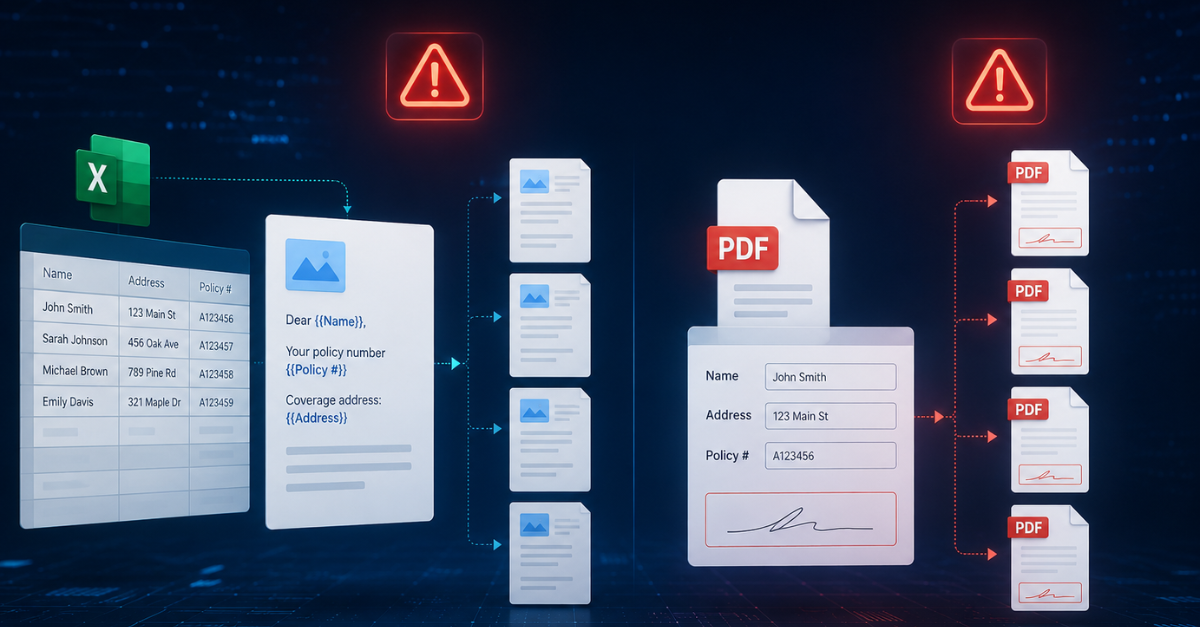
Most enterprises still rely on document automation that handles predictable tasks – generating a letter, assembling a pack, or triggering a notification. But enterprise workflow transformation demands greater intelligence. Workflows must respond to conditional logic, multiple data sources, dynamic business rules, and shifting regulatory frameworks.
Traditional document automation struggles when:
- Documents require complex, logic-driven branching
- Multiple systems need to supply or validate data
- Compliance steps must be enforced consistently
- Teams need visibility across the document lifecycle
- Template governance requires strict auditability
This is where the leap to orchestration begins. Organisations no longer want faster tasks. They want coordinated, governed, logic-driven document automation that eliminates risk and ensures every output is accurate, compliant, and consistent.


Why orchestration is shaping the next era of document governance
The move toward smart document infrastructure is driven by several enterprise realities:
1. Data complexity is increasing
Documents now pull from CRMs, core systems, APIs, third-party data services, and regulatory repositories. Orchestration ensures that every data point is validated, synchronised, and transformed into compliant document output.
2. Governance is non-negotiable
Compliance document governance is no longer just an audit requirement. It is a continuous operational discipline. Orchestration enforces rules, oversees version control, ensures mandatory steps are followed, and eliminates manual interpretation.
3. Scale demands coordination
High-volume processes such as renewals, regulatory communications, and customer correspondence cannot rely on ad hoc automation. Orchestration manages concurrency, load distribution, exception handling, and failover across document-intensive ecosystems.
4. Customer expectations require precision
Whether onboarding a policyholder, issuing a contract, or generating a personalised communication, enterprises need document workflows that adapt instantly to context. Orchestration transforms customer journeys by ensuring accuracy, speed, and consistency at scale.
The orchestration era: where documents, data, and decisions converge
In orchestrated environments, document-centric processes are no longer linear. They are adaptive systems.
A workflow orchestration platform coordinates:
- Data retrieval, validation, and transformation
- Conditional logic and business-rule evaluation
- Document generation at enterprise scale
- Approval, review, and audit trails
- Integration with digital signatures, repositories, and CRM systems
- Error handling, routing, and automated compliance checks
This provides what automation alone never could: a unified operational backbone that connects people, systems, and documents.
Orchestration enables organisations to run document operations with complete clarity – from template governance to generation, distribution, storage, and lifecycle oversight.
Where DocFusion enters the transformation
Enterprises are now seeking platforms that move beyond task automation and deliver true workflow orchestration at scale. DocFusion was built precisely for this shift. As a smart document infrastructure platform, DocFusion provides the intelligence, governance, and integration depth needed to orchestrate the full lifecycle of enterprise document generation.
Instead of disconnected automation, DocFusion delivers:
- Centralised template governance with full auditability
- Logic-driven document automation that adapts to data and rules
- Workflow orchestration that connects people, processes, and systems
- High-volume batch capabilities for large-scale regulatory and operational output
- Seamless connectivity with CRMs, core systems, APIs, and cloud repositories
This is how enterprises transform fragmented processes into a controlled, intelligent, orchestrated environment.
The shift has already begun – and enterprises that orchestrate will lead
The move from document workflow automation to orchestration is not a future prediction. It is happening across financial services, utilities, insurance, healthcare, public sector operations, and any industry where accuracy and compliance are essential.
Organisations that embrace orchestration now will gain:
- Faster time-to-value
- Stronger compliance posture
- Greater operational resilience
- Seamless scale for document-intensive processes
- Consistent, trusted outputs across customer journeys
Those that remain in automation-only environments will feel increasing pressure: more manual oversight, more compliance exposure, more system fragmentation, and more operational bottlenecks.
Get started with orchestration here.