DocFusion

How enterprise document generation compounds AI at scale
Enterprise document generation is the layer that turns AI into an operating dividend. A deterministic template engine produces the same output every time at near-zero marginal cost per document, under a regulator’s exact format specification, and generative AI compounds the design-time work around it: authoring, migration, output QA, and portfolio-wide analysis all get faster. The architecture that wins pairs AI at the authoring stage with a deterministic template engine at the production stage, and it compounds both curves at enterprise scale.
This is the architectural case for that split, written for IT and architecture leads shaping a document-generation program, and for the executive who needs the one-line version for the board.
The vibe-coded mail-merge story, and where it lands
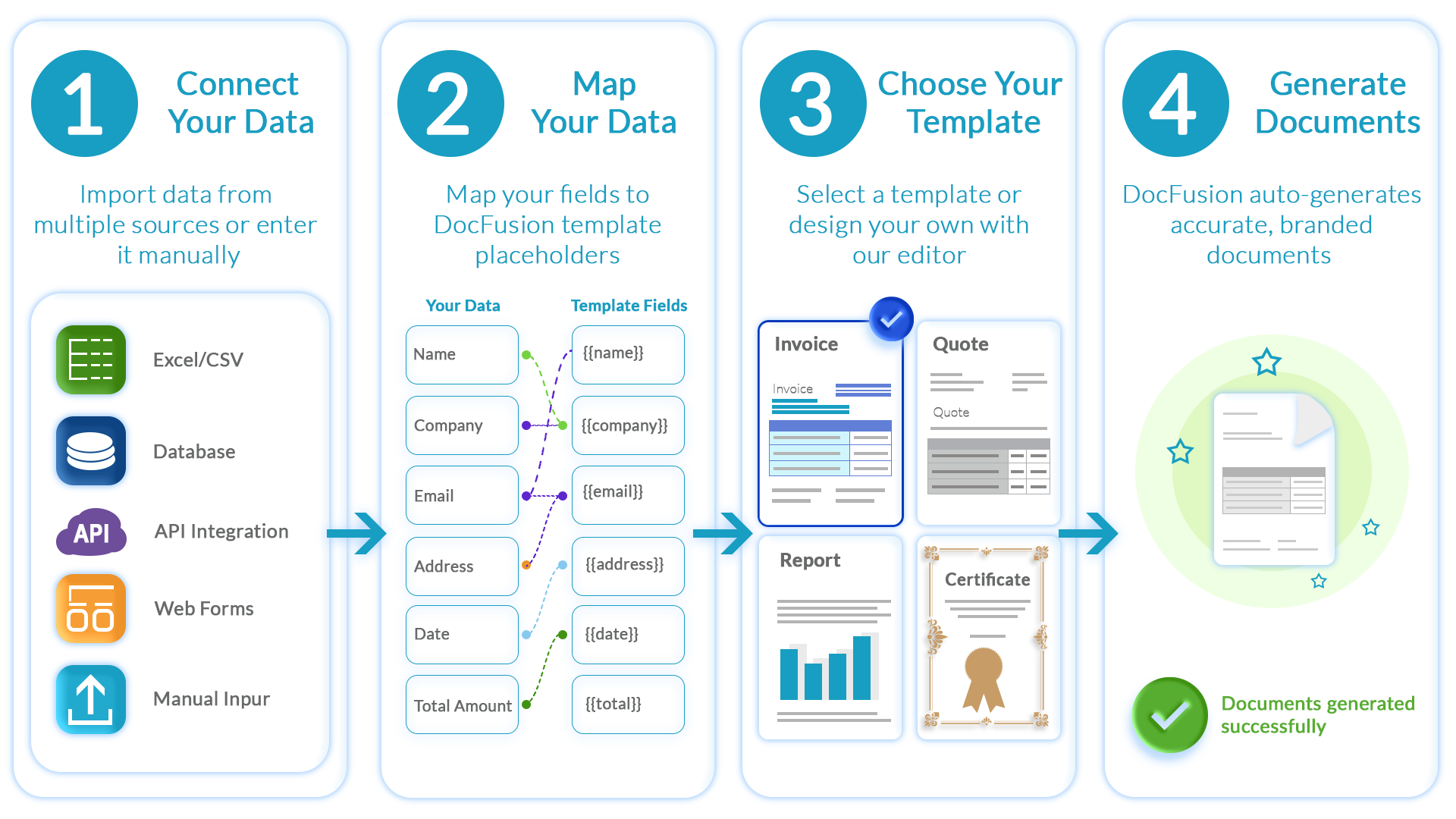
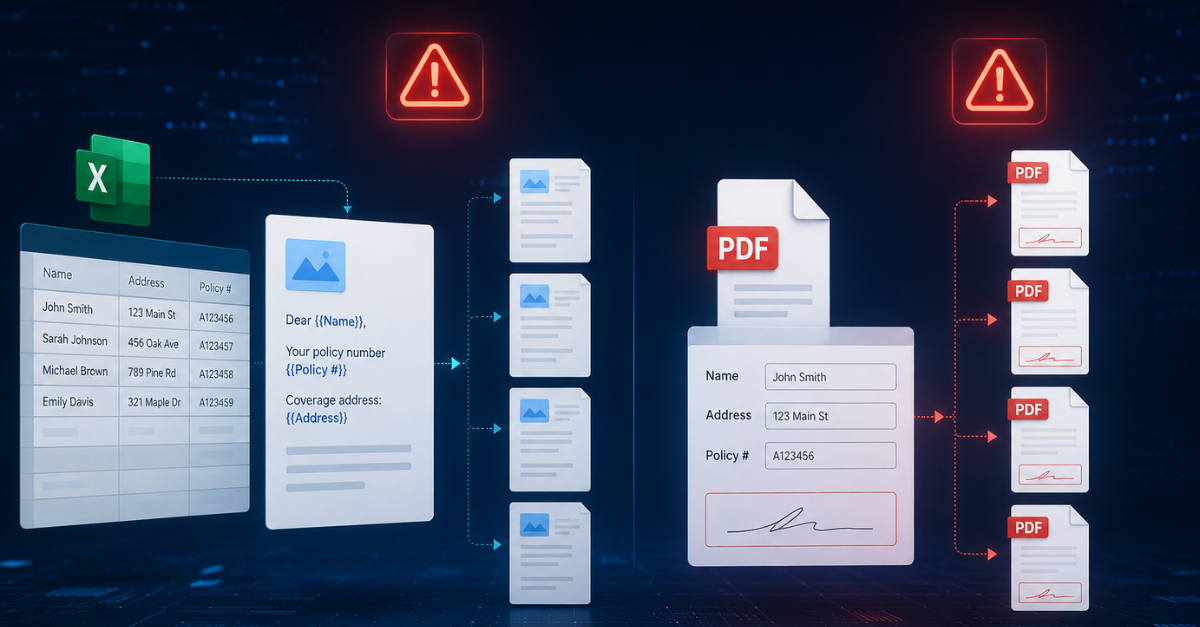
A developer asks a coding assistant to vibe-code a mail-merge utility on a Friday afternoon. By Friday evening, the utility works. It reads a CSV, walks a Word template, fills the merge fields, exports a PDF. For ten documents to a friendly customer list, this is fine. It will probably handle a hundred.
What arrives on Monday is the real work. The same team now points at a hundred thousand customer statements going out next Tuesday, to a regulated audience, where each document carries unique data, conditional disclosures, repeating product holdings, multi-language footers, a regulator-mandated format specification, an archival PDF/A requirement, and a non-negotiable audit trail.
That is the moment the Friday demo hands off to the enterprise document generation engine, and the architectural question becomes load-bearing: which parts of this work does generative AI compound at scale, and which parts does the deterministic engine do faster than anything else?
The answer is architectural. Enterprise document generation compounds AI in five specific places. It is worth naming each one because each one is where the operating dividend actually shows up.
Five places enterprise document generation compounds AI
Scale
A deterministic template engine has near-zero marginal cost per document at enterprise scale: it loads a compiled template once and renders against streamed data records, so the cost of the hundred-thousandth document is the same as the cost of the second. That runtime economics is the substrate. AI compounds on top of it by absorbing the design-time work that used to gate scale: template authoring that used to take a week now lands in an afternoon, migration that used to take a quarter now runs in bulk with per-template human sign-off, and portfolio analysis that used to be unstaffable at millions of documents per month is now a query.
The scale story compounds in both directions. Runtime scales because it is deterministic. Design time scales because AI extends the analyst layer. The two curves reinforce each other.
Complexity
Enterprise templates carry conditional logic, repeating groups for multi-product holdings, multi-language support per customer preference, accessibility tagging for PDF/UA conformance, PDF/A archival format for long-term retention, document-level encryption with role-based decryption keys, watermarks for draft and confidential states, embedded fonts that guarantee rendering across decades, and regulator-specific format specifications that arrive as a bytewise PDF profile and tolerate no variance.
Every one of those complexity dimensions is design-time work before it is runtime work. AI compounds the design-time side: it helps draft a conditional block, propose a repeating-group structure, flag a language-coverage gap, or surface an accessibility violation before the template ever runs. The deterministic engine then produces the byte-stable output that meets the format contract at scale.
The pattern is the same one every serious regulated-output operation converges on. A template that captures the contract. An engine that renders it. A design-time authoring layer that AI now extends.
Cost per page
Enterprise document generation runs well under one cent per produced page on the relevant pricing tier for batch statement and policy production. That cost curve is what makes high-volume regulated document operations economically viable in the first place, and it does not carry an inference bill. The AI-augmented architecture keeps runtime cost low by design and puts generative assistance where the cost is small and the value is high: authoring hours, migration hours, QA hours, analyst hours. Every one of those is a small, bounded, reviewable use of inference that pays back a much larger downstream cost.
The “five times the infrastructure” claim from the older mail-merge debate held for the same reason. A mail-merge approach at enterprise scale needed roughly five times the server footprint a purpose-built engine used for the same throughput. The AI-augmented enterprise document generation architecture avoids that trap by keeping the runtime engine purpose-built and letting AI compound the design-time work around it. Both cost curves land in the right direction.
Compliance
Enterprise document generation programs operate inside a governance framework. Templates are version-controlled, edits are role-gated, changes are reviewed and signed off, production runs are logged, and every output document is traceable to a template version, data input, job ID, and named operator. Segregation of duties applies: Legal owns the footer, Marketing owns the header, Compliance owns the disclosure, and none of those owners can edit the others’ content.
These governance primitives are exactly the surface AI slots into cleanly. A design-time AI recommendation enters the template registry through the same sign-off gate a human recommendation would. A migration AI produces converted templates that a human reviews before they join the active library. A QA AI writes into the decision log alongside the reviewer. Everything AI touches inherits the audit trail that enterprise document generation programs have built over the last two decades. That is the compliance advantage that compounds.
The convergence goes both ways. ISO/IEC 42001 wants a documented AI management system; the NIST AI Risk Management Framework wants a named accountable owner per AI use case; the EU AI Act’s high-risk obligations (in force from August 2026) want explainability, logging, and human oversight for any AI involved in regulated decisions. Enterprise document generation programs already run the machinery those frameworks require. AI that lives inside that machinery inherits governance-fit on day one.
Consistency
This is the closer, and it is the reason the compounding is safe. Enterprise document generation delivers byte-stable output: the same template rendered against the same data produces the same document, every time, on every environment, across every software upgrade. That determinism is what makes format-specification conformance provable, what makes an audit reproducible, and what makes a regulatory filing survive scrutiny. It is also what gives generative AI a well-defined surface to compound against.
Determinism is a property, not a limitation. Generative AI works probabilistically by design, which is exactly what makes it the right tool for the creative surface of the work: drafting a template fragment from a natural-language brief, proposing a variation, suggesting a QA candidate. Enterprise document generation gives that creative surface a deterministic partner, so the AI output can be reviewed, versioned, and rendered against a regulator-acceptable contract. AWS has published on the value of overlaying deterministic controls on generative inference for regulated industries. Augment Code’s 2025 analysis distinguishes deterministic AI (same input, same output) from non-deterministic AI (same input, different output) and notes the distinction is what makes an AI-augmented system auditable. Clavis Technologies makes the same structural argument: pairing the two behaviours is what turns AI into an operating advantage in regulated document workflows.
The industry has visible evidence of what happens when the pairing is absent. The legal profession has the clearest documented view because hallucinated citations are falsifiable in court records: by 2026, more than seven hundred court cases involve AI-generated content that landed in production without a review gate, and independent measurements of LLM hallucination rates on legal queries land between sixty-nine and eighty-eight percent. More than eight in ten surveyed legal professionals have personally encountered fabricated case law in AI-generated work. Every one of those examples is an argument for the design-time / runtime split, not an argument against AI: the same AI that produced the fabricated citation is the AI that, inside a document generation program with a review gate, would have surfaced the same candidate for a human to accept, modify, or reject.
Enterprise document generation makes the compounding safe by putting AI on the design-time side of an explicit architectural line. Authoring AI proposes; a human accepts. QA AI flags; a human confirms. The runtime engine renders exactly what the reviewed artefact says. That is the architecture that lets AI carry as much of the design-time workload as it can, safely.


The historical pattern: Document generation compounded with RPA, and compounds with AI
The AI-and-docgen conversation echoes the RPA-and-docgen conversation from the late 2010s. RPA was going to absorb the document-production layer by scripting it. What actually happened was that RPA compounded with the document generation engine: RPA absorbed the surrounding workflow (data staging, approval, system-of-record update), and the engine kept producing the documents. The two turned out to be complementary, and the combined stack was materially better than either layer alone. RPA needed a deterministic engine to drive, and the document generation engine was already that thing.
AI is following the same shape. The places AI earns its place are design-time and advisory: template authoring that compresses a week of analyst work into an afternoon; migration that converts thousands of legacy templates with human sign-off per template; output QA across batch runs that surfaces likely template flaws to a human investigator; portfolio analysis across millions of documents that surfaces drift, anomaly, or fairness issues a human review can act on. Each of those extends the enterprise document generation program without disturbing its deterministic core.
The RPA wave made document generation faster. The AI wave is making it faster still. The pattern that survives both waves is the same pattern: a deterministic engine at the centre, and every technology wave adding capability around it.
Where AI earns its place in document generation
AI is excellent at the design-time and advisory work document generation programs have historically had to hire people for. Each of those places is where the operating dividend shows up.
Where AI is earning its place:
- AI-assisted template authoring. Designers describe what a section should do; the AI drafts the fragment; a human approves before it enters the template library. Authoring cycles compress; the template library gets richer without adding headcount.
- AI-assisted migration. Legacy templates are converted in bulk; each converted template is reviewed and signed off before joining the active library. Migration timelines compress dramatically, and nothing changes silently. Procurement decisions that used to depend on migration cost start to break in the modern platform’s favour.
- AI-assisted output QA. Sampling across batch runs flags likely template defects (a conditional firing on the wrong segment, a repeating group swallowing the last record, a translation that drifted). The AI surfaces candidates; a human confirms and acts. Late-stage errors get caught earlier.
- AI-assisted portfolio analysis. Document estates of millions per quarter contain patterns a human reviewer cannot see at scale: segment-level rendering issues, language coverage gaps, archival-format conformance drift. The AI is the magnifying glass; the remediation decision stays with a person. Portfolio hygiene compounds.
The AI is advisory. The artefact it produces is reviewed before it enters production. The production engine is something the regulator can audit on its own terms. That is the architecture that scales, and the architecture a compliance officer can sign.
The architecture that wins: AI at design time, determinism at runtime
The architecture is a split.
Design time is generative. Authoring is faster. Migration compresses by an order of magnitude. Portfolio analysis surfaces issues nobody had time to find before. The AI does the heavy lifting; a human approves every consequential output.
Runtime is deterministic. The template engine renders the same template against the same data and produces the same document every time. Output is byte-stable. Format conformance is provable. The audit trail names the template version, the data input, the operator, and the job. The regulator sees a system that behaves the same way at scale on Tuesday morning as it did during the review on Monday afternoon.
This architecture captures the productivity dividend at design time (authoring, migration, QA, portfolio analysis all get faster), preserves the audit posture at runtime (the production engine is deterministic and logged), and keeps the hallucination surface contained on the reviewed side of the line. Goldman Sachs’s March 2026 “Will AI Eat Software?” analysis described the same shape when it rated the rip-and-replace scenario for enterprise transaction software as the lowest-risk outcome in its bear case: AI agents depend on structured, traceable data and well-defined process boundaries, and the engines that maintain those structures are the substrate AI extends, not replaces.
It is the architecture last month’s campaign argued for. AI as accelerator at design time. Deterministic engine at runtime. That is the architecture that captures the compounding advantage.
The vendor signature that turns AI into advantage
The document generation vendors that turn the AI cycle into a compounding advantage share one architectural signature: an explicit separation between generative assistance at design time and deterministic rendering at runtime, drawable on a whiteboard in two minutes.
The signature shows up in the answers the vendor gives fluently. Where in the workflow does inference run, and where is its output reviewed before it reaches a customer? What does the audit trail record about AI’s role in any artefact it touched? How can AI features be scoped up or down without touching the runtime? Who is the named human accountable for each AI-produced artefact that enters production? A vendor whose architecture compounds AI has a diagram and a paragraph ready for each.
The signature also shows up in how the vendor thinks about the AI feature roadmap. Every AI capability is added on the design-time side of the line. Every AI capability inherits the same review gates, decision logs, and role-based access the template library already runs on. Every AI capability is described in terms of the operating dividend it produces (authoring hours, migration hours, QA hours, portfolio-analysis hours) rather than as replacement for the runtime engine. The vendors that lean into AI hardest are the ones that also lean into determinism hardest, because they know one is what makes the other compound.
What to look for, what to demand, what to refuse
Three short lists for a buyer evaluating a document generation platform with an AI story.
What to look for. A documented split between authoring-time AI assistance and runtime deterministic rendering. Per-template human sign-off on any AI-produced change. A decision log recording which AI recommendation was accepted, modified, or rejected, by whom and when. Grounded, in-tenant operation for any AI feature touching customer data. A standards-aligned integration story instead of a single proprietary interface.
What to demand. Byte-stable output from the production engine across runs, environments, and software upgrades. A named accountable owner per AI feature on the vendor side. Explainability documentation for any AI recommendation touching a regulated artefact. Conformance documentation for the relevant format specifications (PDF/A archival, PDF/UA accessibility, regulator-specific profiles).
What to refuse. A platform that has replaced the template engine with inference. A platform whose AI cannot be turned off without breaking the runtime. An audit trail that does not record the AI’s role in any output it touched. AI features that require sending tenant data to a public model without a data-residency and training-exclusion guarantee. A vendor that cannot draw the design-time / runtime split on a whiteboard.
Key takeaways
- Enterprise document generation is the layer that turns AI into an operating dividend: a deterministic runtime that scales at near-zero marginal cost, and a design-time surface AI extends across authoring, migration, output QA, and portfolio analysis.
- The five places the compounding shows up are scale (runtime is near-zero marginal cost; AI extends the analyst layer), complexity (design-time authoring compounds regulator-format expertise), cost per page (AI-augmented architecture keeps runtime cheap and puts inference where it pays back), compliance (governance primitives already exist; AI inherits them cleanly), and consistency (byte-stable runtime output makes the compounding safe).
- Enterprise document generation programs already run the machinery ISO/IEC 42001, the NIST AI Risk Management Framework, and the EU AI Act (high-risk obligations in force from August 2026) require. AI that lives inside that machinery inherits governance-fit on day one.
- The architecture that captures the compounding advantage is AI at the authoring and advisory stages with a deterministic template engine at runtime. The split lets AI carry as much of the design-time workload as it can, preserves the audit posture, and puts the human review exactly where it adds the most value.
- The procurement question is one sentence: can the vendor draw the split between AI at design time and determinism at runtime on a whiteboard in two minutes, and does the audit trail record every artefact AI touched?
Book an architecture review for ai-augmented document generation
We run architecture reviews for AI-augmented document generation. We bring the whiteboard version, the procurement checklist, and the audit-trail anatomy. You bring the regulator constraints and the volume profile. The session produces an architecture diagram and a risk register your buying committee can sign.
Book an architecture review for AI-augmented document generation at docfusioncloud.com/contact.
Related reading on docfusioncloud.com: the companion piece on responsible AI in document generation at docfusioncloud.com/blog, and the platform overview at docfusioncloud.com.